
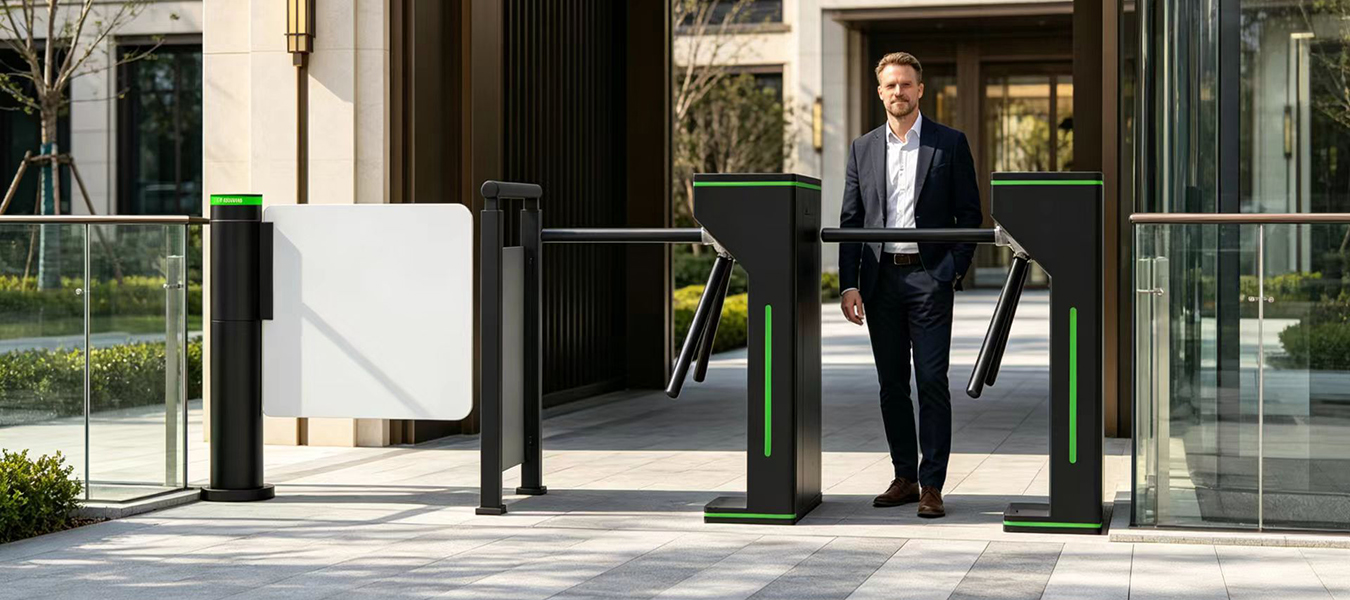
Tripod turnstiles, also known as 3-arm waist-high turnstiles, remain one of the most cost-effective and reliable pedestrian access control solutions on the market. Designed to permit only one person per valid access credential, they balance security, throughput and budget better than many flap barriers, speed gates or full-height turnstiles for factories, construction sites, gyms, schools, stadiums and office staff entrances.
If you are specifying a waist high turnstile for a factory gate, gym, school, or construction site, a tripod turnstile is often the first option on the table. It is compact, mechanically straightforward, and good at enforcing one person per credential — but easy to buy poorly if you only compare unit prices.
This tripod turnstile buying guide is written for distributors, system integrators, contractors, and facility managers buying for Europe, the United States, the Middle East, Malaysia, and Singapore. It explains how the gate works, where it belongs, and what to put in a quotation request.
What Is a Tripod Turnstile?
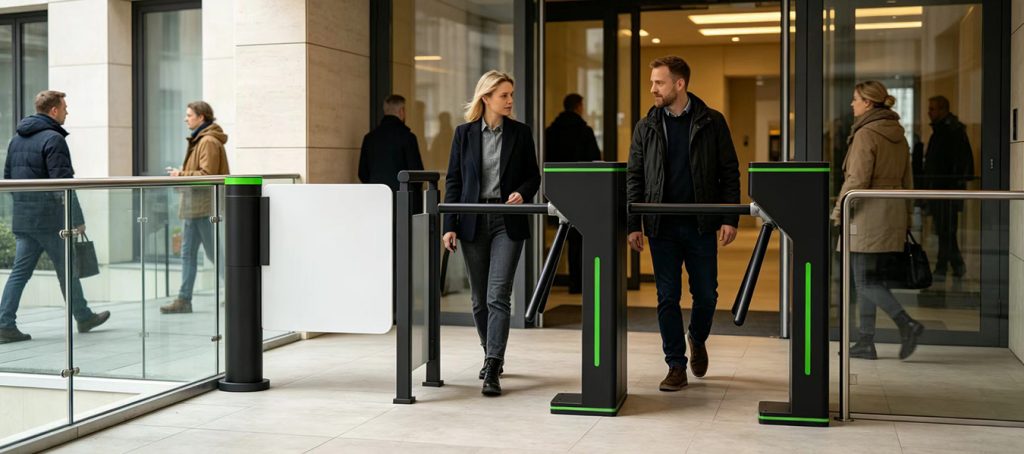
A tripod gate turnstile is a waist-height access turnstile gate with three rotating arms spaced 120° apart. When a valid signal is sent from an access reader, the lock releases, the arms rotate to allow one pedestrian through, then reset and lock again. The physical barrier is its biggest advantage: it stops casual piggybacking and unauthorised tailgating that card readers on ordinary doors often miss.
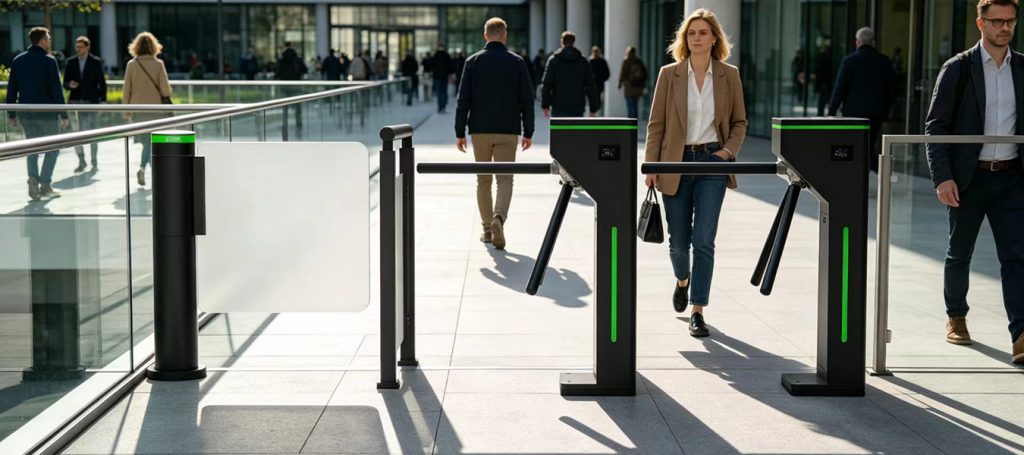
The arms create a physical “one person, one passage” rule, which is why these gates remain common at staff entrances, gyms, campuses, stadium side gates, and construction sites. What a tripod does not do is create a wide lane. Standard passage width is typically about 550–600 mm, so wheelchairs, strollers, tool carts, and luggage need a separate swing barrier turnstile beside the tripod bank.
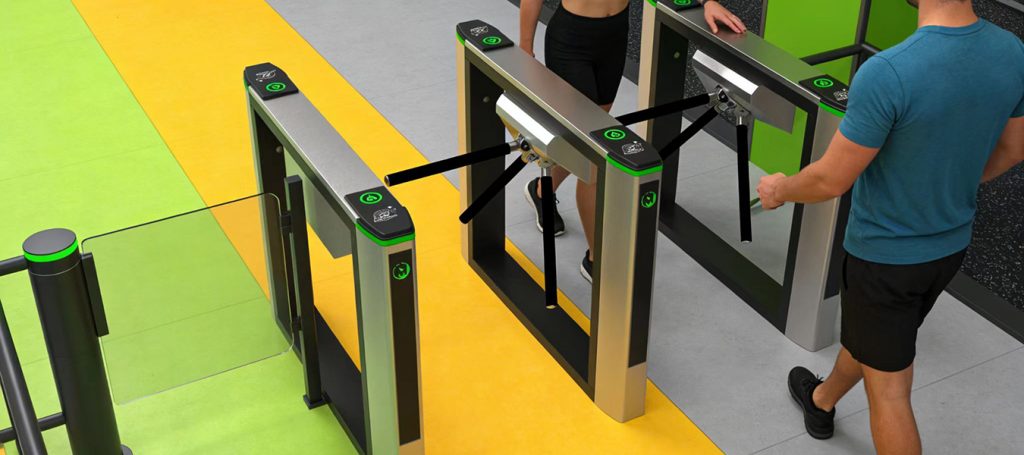
Step 1: Match the Turnstile Type to Your Site
The first choice is the operating mechanism. The three main categories are manual, semi-automatic and fully automatic tripod turnstiles.
Manual tripod turnstile Manual models have no electric lock or motor. Visitors push the arms to rotate. They are low-cost, fail-safe and common for stadium exit lanes, temporary crowd control and low-security public zones. They cannot connect to access control systems and offer no credential verification.
Semi-automatic tripod turnstile (most popular) Semi-automatic tripod turnstiles use an electromagnetic lock. After valid verification, the lock releases, and the user pushes the arm to pass. The arm automatically locks again after rotation or after a configurable timeout if nobody walks through. This is the standard choice for factories, construction sites, schools and gyms. It delivers reliable security at a reasonable price point.
Mairs’ M Series Tripod Turnstile MT100 is listed as semi-automatic, with a fully automatic mechanism available as an option in the product brochure. The product page also states that the arm drops automatically when power is cut.
Fully automatic tripod turnstile Automatic versions use a motor to drive the arm rotation after access approval. The arm moves smoothly without pushing. They feel more premium, work well for high-traffic indoor lobbies and reduce wear from repeated pushing. They cost more and require stricter maintenance for the motor assembly.
Step 2: Select the Right Material & IP Rating for Environment
Indoor and outdoor installations have completely different hardware requirements.
- SUS304 stainless steel: The standard option. Resists rust, scratches and everyday humidity. Suitable for most indoor sites and covered outdoor entrances.
- SUS316 stainless steel: Recommended for coastal areas, salt-air environments or sites with chemical exposure. It offers superior corrosion resistance but raises the unit cost.
- Painted carbon steel: Budget indoor-only option. Not suitable for wet, dusty or outdoor locations.
Check the IP rating for outdoor or exposed positions. IP54 is typical for dust and splash resistance; IP55 or IP56 is preferred for fully uncovered outdoor installations. You should also confirm the operating temperature range. If you deploy in cold regions, ask about built-in heaters and temperature-resistant electronics to avoid freezing locks and reader failure.
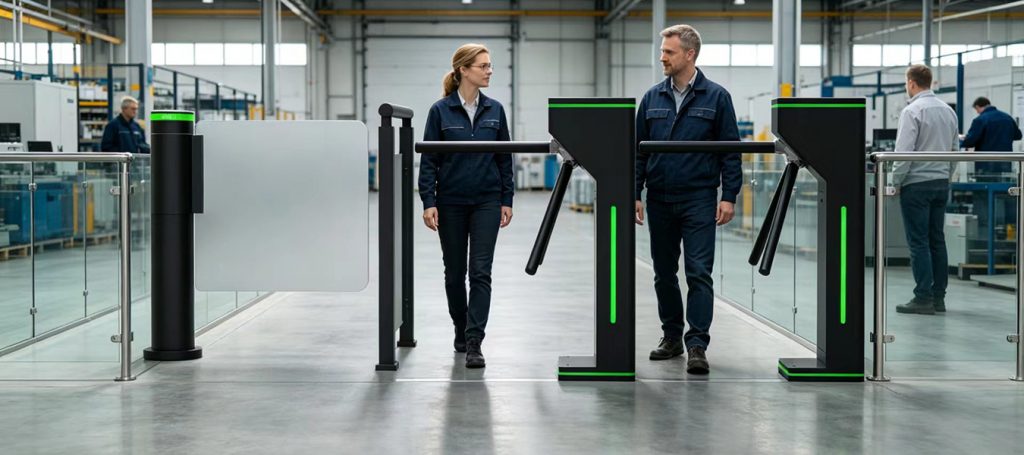
Step 3: Calculate Pedestrian Throughput & Number of Lanes
Many buyers only look at average daily visitors and underestimate peak rush-hour traffic. The real test is your 5–10 minute peak flow: shift change at a factory, school dismissal, gym opening or stadium entry.
Standard tripod turnstiles handle roughly 25–35 people per minute under normal conditions. Rejected scans, slow users and tailgating attempts will lower real throughput. If your peak exceeds this, add extra lanes rather than overloading a single gate. It is cheaper to add one extra lane than to deal with queues, complaints and rushed security breaches.
Step 4: Check Security Features to Meet Your Risk Level
Basic tripod turnstiles only lock and unlock. For better security, prioritise these features:
- Anti-tailgating / anti-piggyback infrared sensors: Detect whether a second person tries to follow closely behind the authorised user and trigger an alarm.
- Automatic reset: If a credential is approved but no one passes within the set time, permission cancels automatically.
- Emergency free-pass function: Critical for fire safety. When the fire alarm signal triggers, the arms unlock and drop or freewheel for fast evacuation.
- Anti-rush lock: Blocks forced pushing without valid access signals.
- Directional control: Set lanes as entry-only, exit-only or bidirectional from software.
For construction sites and high-security factories, anti-tailgating sensors and emergency release are non-negotiable. For low-risk gym member access, a basic semi-automatic model may be enough.
Step 5: Verify Access Control Integration Compatibility
Before buying, confirm what readers and protocols the turnstile controller supports. Common options include:
- Wiegand (26/34 bit) for RFID card readers
- RS485
- TCP/IP network connection
- QR code scanner
- Fingerprint and facial recognition modules
- Attendance, time clock and visitor management software
If you already run an existing access platform, ask the supplier for a test document or SDK. A turnstile with closed, proprietary firmware can lock you into one software vendor and limit future upgrades. Open protocol controllers give you far more flexibility.
Step 6: Budget Breakdown — Don’t Only Compare Unit Price
Tripod turnstile pricing depends on mechanism, material, sensors, readers and customisation. A simple comparison of cabinet price is misleading. Your full project budget should include:
- Turnstile main body and tripod arms
- Access readers (RFID, QR, biometric)
- Controller and power supply
- Infrared sensor upgrade
- Outdoor waterproofing or cold-climate heater option
- Installation hardware, wiring and floor anchoring
- Software licence, cloud platform or local server
- Shipping, customs and on-site commissioning
- Warranty and maintenance package
Entry-level semi-automatic SUS304 indoor tripod turnstiles are the most popular for bulk factory and site projects. Premium automatic, IP-rated or 316 stainless steel units will sit at the higher end. For large orders, most manufacturers offer volume discounts, but always confirm lead time and spare parts availability.
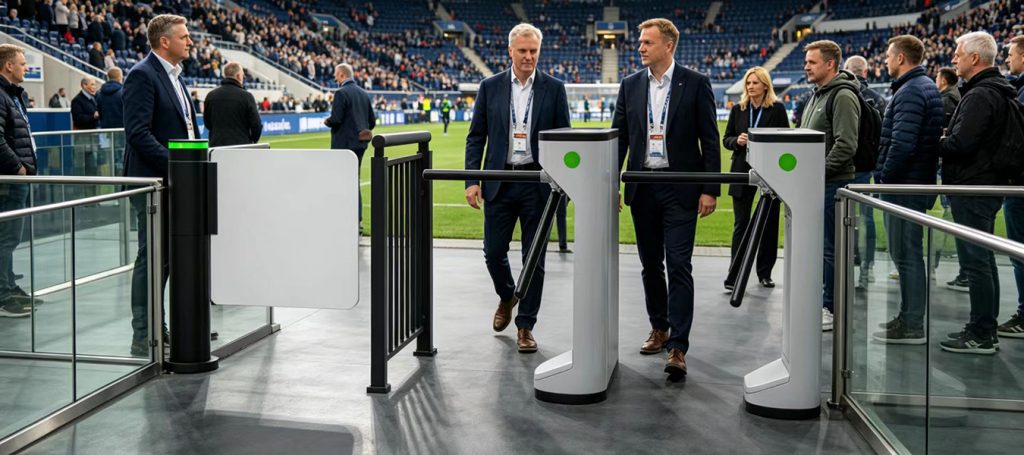
Step 7: Supplier & Quality Checklist
Whether you buy from a local integrator or a direct factory, run through this checklist before confirming the order:
- Request CE, FCC and RoHS certificates for compliance in your target market.
- Ask for warranty terms: standard is usually 1–2 years for main electronics.
- Confirm technical support: remote troubleshooting, wiring diagrams and integration guides in your language.
- Check customisation options: colour, logo printing, lane layout and arm drop style.
- Ask about spare parts stock: locks, sensors, power supplies and control boards.
- Review installation support: site survey, wiring recommendations and emergency wiring setup.
Factory direct purchase often delivers better pricing for multi-lane projects, but vet suppliers carefully. Look for verified project references from sites similar to yours, such as construction turnstiles, gym access or factory attendance gates.
Step 8: Installation & Compliance Notes
Tripod turnstiles need solid concrete floor mounting. Floors with hollow panels or weak tiling require reinforcement. Keep enough clearance beside each lane for wheelchair or bypass access if local codes require it.
Fire safety rules are especially important. All turnstiles on escape routes must have a fail-safe emergency release. In a power outage or fire alarm event, the arms must not block evacuation. Document this function for your safety inspector.
Mairs Turnstile Tripod Options, Including OEM and ODM
Mairs Turnstile is a pedestrian turnstile manufacturer in Shenzhen, China. It builds tripod gates alongside flap barriers, swing gates, speed gates, and full height turnstiles, and supports OEM/ODM work — logo, color, size, and deeper custom design, with drawings and 3D renderings. Browse the current range in the tripod turnstile category.
Three series models are useful reference points:
MT-KQ100, Coating Series. A compact, baked-coating design that Mairs describes as suitable for narrow channels. It can sit beside other Coating Series lanes, including a wide swing lane.
MT-LX100, Meteor Series. A classic Meteor-element design with a black-and-white baked finish, RGB column indicators, and a modular acrylic swipe panel, positioned for tighter, more design-conscious spaces. See the Meteor Series overview.
MT100, M Series. A longer bridge-style cabinet. The M Series uses a snap-on chassis that the company says makes the structure more secure and installation more convenient. The brochure lists a SUS 304 and powder-coated housing, indoor or outdoor use, and a 3-million-cycle mechanism.
Who Should Choose a Tripod Turnstile Instead of Other Turnstiles?
Tripod turnstiles are ideal if you want a low-to-medium cost physical barrier with moderate throughput.
- Choose tripod turnstile: factory, construction site, gym, school, stadium, staff canteen, low-budget office back entrance.
- Choose flap barrier / speed gate: premium office lobby, airport, high-end commercial building where aesthetics and fast flow matter more.
- Choose full-height turnstile: prison, data centre, high-security perimeter where climbing over is a major risk.
Frequently Asked Questions
Q: Can tripod turnstiles work outdoors?
A: Yes, but you must select SUS304 or SUS316 stainless steel with a suitable IP rating. Add heating modules if the location sees freezing temperatures. Indoor models will quickly fail outdoors from moisture and temperature swings.
Q: Can tripod turnstiles stop tailgating completely?
A: Basic models cannot. Add infrared anti-tailgating sensor beams to detect piggybacking and trigger alerts. They are more effective than standalone card readers, though not as strict as some optical speed gate sensors.
Q: Do tripod turnstiles work with existing access control systems?
A: Most support Wiegand and TCP/IP, which work with most mainstream access software. Always confirm protocol compatibility before purchase.
Q: What happens during a power cut?
A: Good-quality tripod turnstiles include emergency release. Many can connect to UPS backup power, and the mechanical arm release must open for emergency evacuation.
Q: How long does a tripod turnstile last?
A: With regular maintenance, quality semi-automatic models can reach 3–5 million operations. Lifespan drops sharply if you skip cleaning, tighten loose arms or ignore water ingress.
Q: How much does a tripod turnstile cost?
Indicative web prices for standard China-factory tripod gates often sit in the mid-hundreds of US dollars per unit, and can run higher with readers, outdoor preparation, or custom finishes. Mairs lists the MT100 at $600 on the product page at the time of writing and, in its gym guide, cites an indicative range of $350–$1,600. Ask for an itemized quote against a fixed specification.
Q: What is the difference between OEM and ODM on a tripod turnstile?
OEM generally means the factory builds to your drawings or detailed specification and brand. ODM generally means you start from the factory’s existing design — for example a Coating or Meteor cabinet — and customize approved features such as color, logo, and reader layout.
Q: Do I still need a wheelchair-accessible lane?
Yes, in almost every public or commercial building project. A standard tripod lane is too narrow for wheelchair use. Plan a wide swing or similar accessible gate in the same controlled entrance.
Final Buying Checklist
✅ Define indoor or outdoor environment, temperature range and corrosion risk
✅ Calculate peak pedestrian flow and decide number of lanes
✅ Pick manual / semi-automatic / automatic mechanism
✅ Confirm material: SUS304, SUS316 or painted steel
✅ Select required sensors: anti-tailgating, directional counting
✅ Check protocol compatibility with your access software
✅ Confirm emergency release and fire alarm interface
✅ Compare full project cost, not just cabinet price
✅ Verify warranty, spare parts and after-sales support
A well-selected tripod turnstile gives you years of stable access control, accurate attendance logging and controlled pedestrian flow. The best purchase decision focuses not on the lowest upfront price, but on matching the hardware’s durability, security features and integration capability to your unique site requirements.