
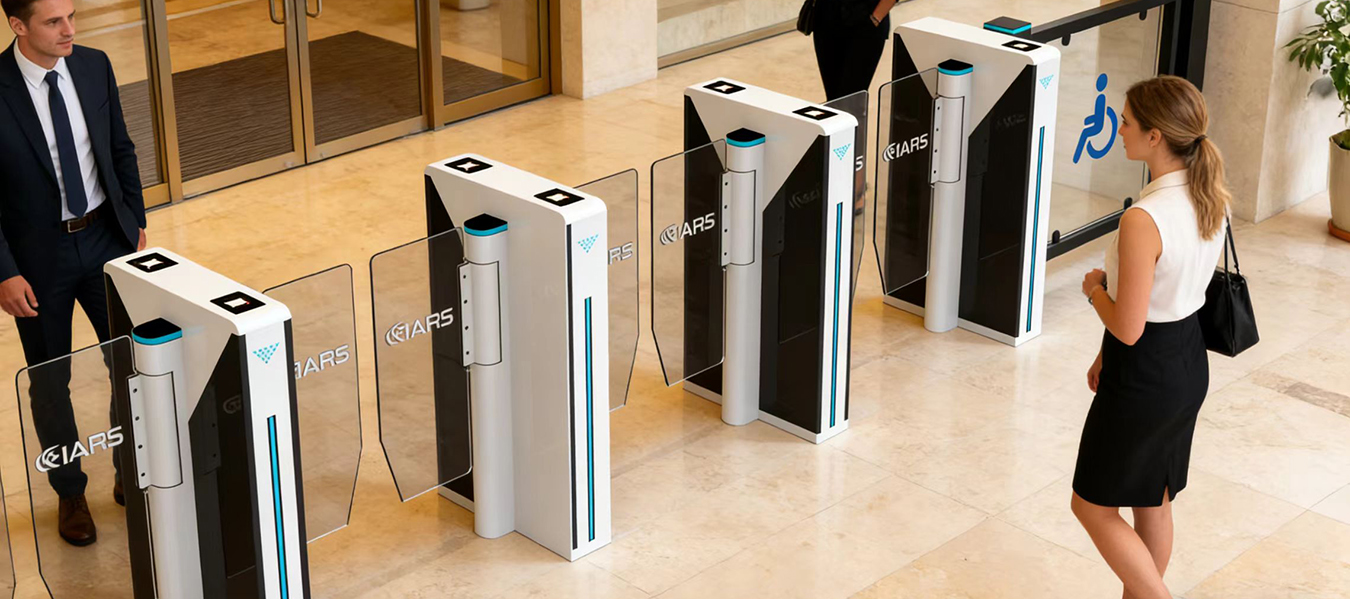
What is an access Control Turnstile?
An access control turnstile is a physical pedestrian security turnstile gate paired with electronic access verification, designed to regulate entry and exit, enforce one-person-per-credential passage, and record every access event in real time. Unlike ordinary doors, turnstiles create a controlled lane that blocks tailgating, piggybacking and unauthorised bypass, making them one of the most widely used perimeter and internal access control solutions for commercial, industrial and public facilities.
When buyers search for “access control turnstile”, they are usually not just looking for a turnstile gate. They want to know which type fits their site, whether it can connect to their existing access system, or verifying compatibility with your existing access control software, card readers, biometrics or visitor management platform. how reliable anti-tailgating works, outdoor waterproof options, compliance, installation, pricing, maintenance and emergency safety rules. This guide covers all core considerations for facility managers, security integrators, contractors and business owners.
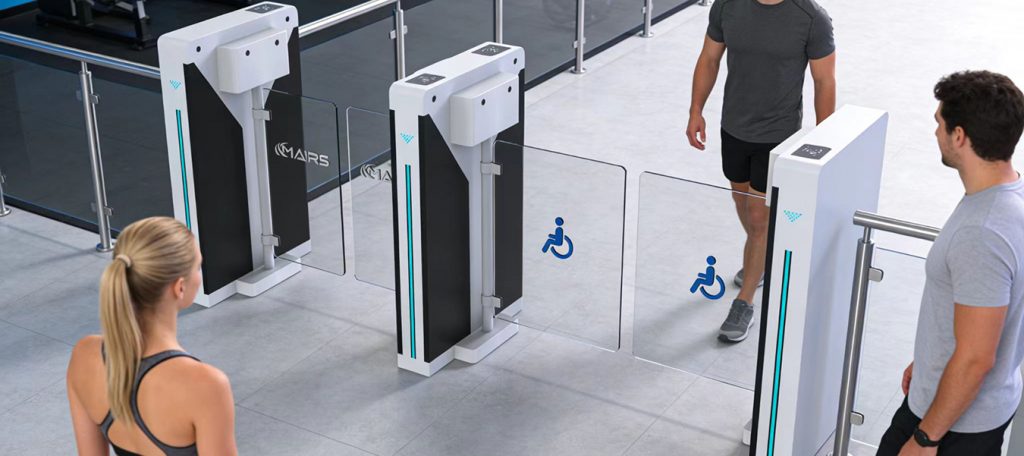
How do turnstiles work with access control
Turnstiles are physical pedestrian barriers that become intelligent entry points when paired with access control hardware and software. Many buyers, facility managers, system integrators and security engineers search this question because they want to understand the signal flow, compatibility, wiring standards, security logic and limitations before selecting, installing or integrating a turnstile into an existing access control platform.
A common misconception: the turnstile itself does not make access decisions. The access control system is the “brain”; the turnstile acts as the controlled physical actuator that opens only after receiving a valid permission signal. This separation is critical for integrators, because it means nearly all standard turnstiles can work with most third-party access controllers, as long as they share a compatible communication interface.
Core components in the combined system
To understand the workflow, it helps to break down the full stack:
- Credential reader: RFID card reader, QR/barcode scanner, fingerprint, facial recognition terminal, keypad or mobile access reader. This captures the user’s identity credential.
- Access control panel / access controller: The decision-making unit. It checks the credential ID against a permission database, time schedule, access group, anti-passback rules and door policy.
- Turnstile main board / lane controller: Receives the relay or network signal from the access controller, triggers the unlock mechanism, reads infrared or optical sensors, controls LED indicators and sends passage events back to the software.
- Turnstile mechanical unit: Tripod arms, swing barrier, flap wing, speed gate glass or full-height rotating rotor. Motors, solenoid locks and sensors manage physical movement.
- Access management software: Stores user permissions, logs every entry/exit, generates reports, manages visitor accounts, triggers alarms and syncs across multiple lanes or buildings.
- Auxiliary devices: Emergency stop button, fire alarm linkage module, alarm buzzer, LED direction indicator, tailgating detection sensor and reset circuit.
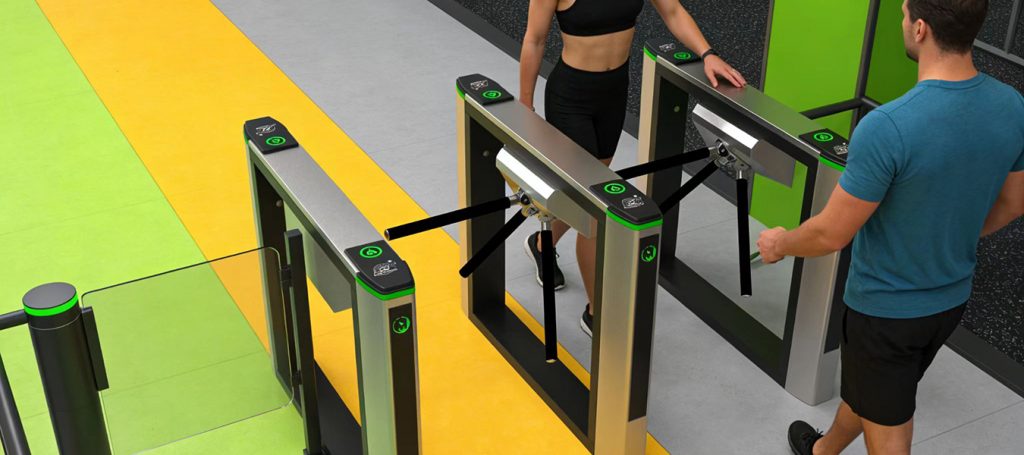
Step-by-step workflow: how they work together
The process repeats every time a user tries to pass through the lane:
- Credential presentation The user approaches the access control turnstile and presents their credential: tapping an RFID card, scanning a mobile QR code, completing a face scan, entering a PIN or using a biometric reader. The reader captures the unique credential ID and forwards it to the access control panel.
- Authorization check by the access control system The controller compares the credential against its database. It also checks rules: is this user allowed at this time? Are they in the correct access group? Is anti-passback active to prevent re-entry without exit? Is the lane set to entry-only, exit-only or free passage?
- Approval signal sent to the turnstile If the credential passes validation, the access controller sends a release signal to the turnstile’s lane board. The most common standard is dry contact relay output, which is simple, universal and supported by almost all turnstiles and access brands. More advanced setups use TCP/IP, RS485 or Wiegand for bidirectional data exchange. If the credential is invalid, expired, or the user has no permission, no release signal is sent. The turnstile stays locked, and may trigger a red light or warning beep.
- Turnstile unlock and passage detection Once the turnstile board receives the valid signal, it unlocks the solenoid or activates the servo/brushless motor. The barrier opens or becomes free to rotate. Infrared or optical sensors inside the lane monitor movement, detect whether someone actually walks through, and identify tailgating, reverse entry or obstruction.
- Event logging and automatic reset After the sensor confirms a successful passage, the access control turnstile sends a “pass completed” event back to the access control software. The system records the user ID, time, lane number and direction. The turnstile then automatically locks and resets for the next user. If the user does not pass within a configured timeout window, the turnstile locks again without generating a pass log.
- Alarm and exception handling Common exceptions include tailgating, forced barrier pushing, reverse entry, credential rejection, and power failure. When sensors detect abnormal behaviour, the turnstile sends an alarm signal to the access control system, which can pop alerts on the dashboard, trigger local sound/light alarms or link to CCTV.
Modern turnstile access control supports TCP/IP, RS485, Wiegand and dry-contact interfaces, so it can run standalone or join a larger security ecosystem with CCTV, alarm systems, visitor software and building management platforms.
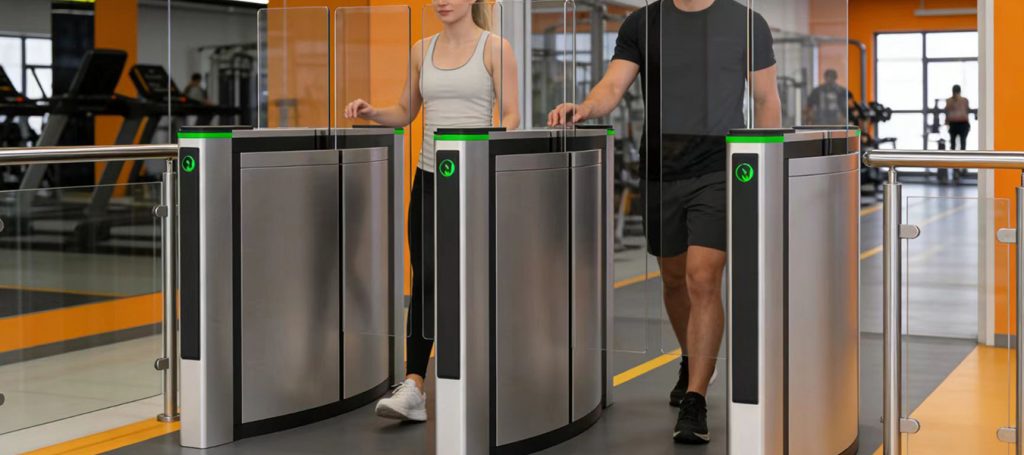
Main types of access control turnstiles
- Tripod turnstile (tripod arm turnstile) Low cost, durable, stainless steel body, moderate security. Best for factories, campuses, construction sites, gyms. Semi-automatic or full automatic models available. Limited throughput, not ideal for high-flow office lobbies.
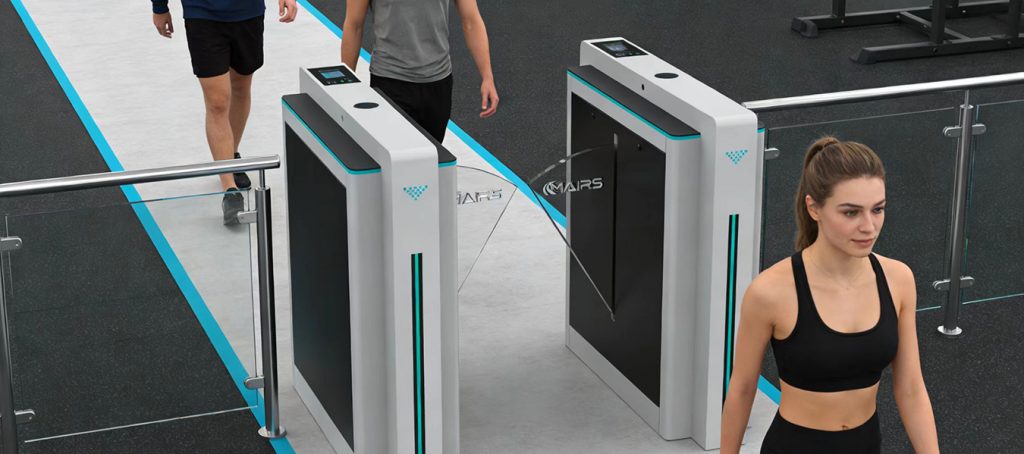
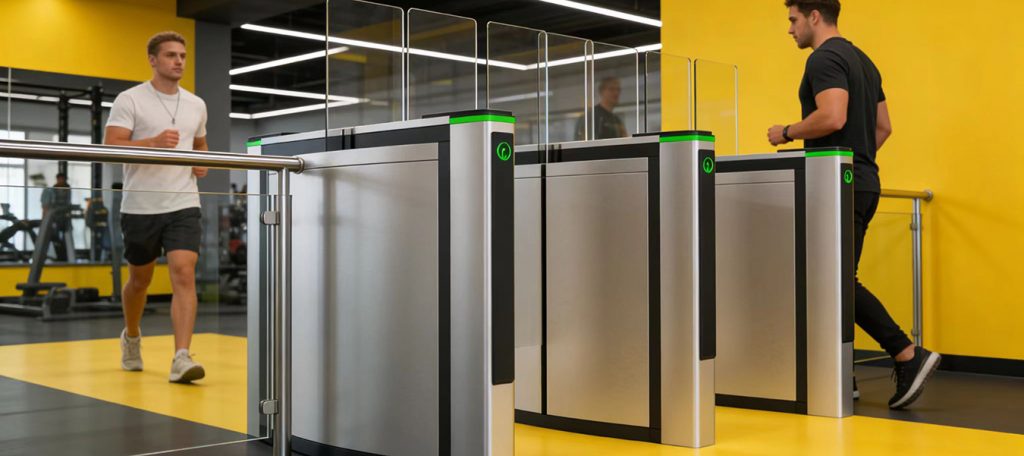
- Flap barrier turnstile (flap barrier gate): Retractable acrylic or metal wings. Clean, modern look, popular for office lobbies, metro stations and high-traffic public buildings. Fast passage, good anti-tailgating optical sensors, lower visual obstruction. Suitable for indoor high-throughput scenarios.Common in office buildings, metro stations, commercial lobbies. Good for medium traffic, anti-tailgating by infrared sensors.
- Speed gate / optical speed turnstile: Optical infrared detection instead of solid mechanical arms. Very fast throughput, sleek design, common in premium corporate offices. Preferred for premium office, data center, bank lobby. Fast pass speed, low noise, high visual appeal.
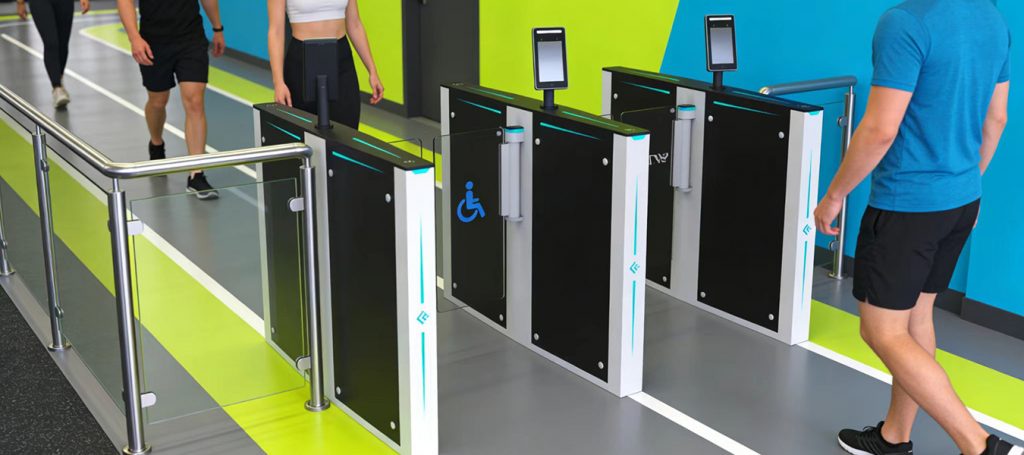
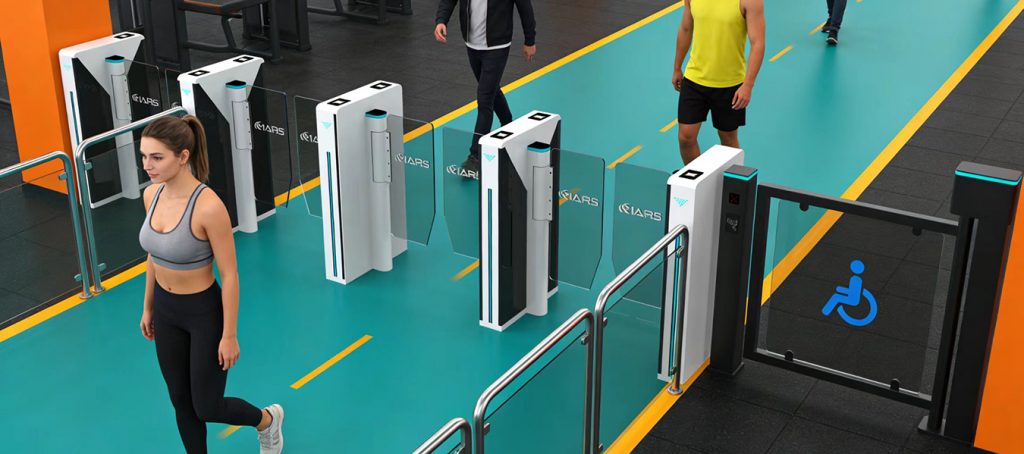
- Swing barrier security turnstile: Swing panels that open inward or outward. More flexible, often used for mixed traffic: staff, visitors, wheelchairs, bikes and service carts. Can be configured as wide lanes. Security level is medium, easier for authorised large-object passage. Wider lane, suitable for wheelchairs, luggage, carts. Often paired with standard lanes for accessibility compliance.
- Full-height access control turnstile: Solid rotating metal cage, floor to ceiling. Highest physical security, almost impossible to climb over or tailgate. Used for prisons, data centers, power plants, stadiums, outdoor restricted zones. Many full-height models support bidirectional control.
- Portable temporary turnstile: lightweight, temporary setup for events, exhibitions, temporary construction access. Quick setup, no permanent foundation required. Usually simpler RFID or QR validation, less heavy-duty for long-term outdoor use.
Key features buyers care about
- Anti-tailgating / anti-piggyback detection: optical sensor or radar detection to alert when a second person follows closely
- Anti-passback: prevents the same credential from being used repeatedly without exit
- Emergency release: power-off free passage, fire alarm linkage, manual unlock for evacuation
- Material: SUS304 / SUS316 stainless steel; SUS316 for coastal, humid, salt-air outdoor sites
- IP rating: IP54 indoor standard; IP65 / IP67 for outdoor waterproof and dustproof turnstiles
- Working temperature: standard indoor 0~45°C; cold-climate models with built-in heater for -40°C extreme environments
- Communication interface: dry contact, Wiegand, RS485, TCP/IP, SDK for integration
- Direction control: one-way or independent bidirectional access rules
- Alarm output: forced entry, tailgating, abnormal reversal, door timeout alarm
- Visitor management linkage: temporary QR / one-time code for guests
Typical industries & applications
- Office buildings, co-working spaces, corporate headquarters
- Manufacturing factories, warehouses, construction sites, contractor management
- Gyms, fitness clubs, stadiums, amusement parks, event venues
- Schools, universities, student dormitories
- Data centres, power stations, high-security facilities
- Public transport, metro, airport auxiliary channels
- Residential gated communities, clubhouses
Supported authentication methods for turnstile access control
Most access control turnstile housings are modular, so you can swap or combine readers:
- RFID / NFC ID & IC cards, key fobs
- QR code / barcode (visitor one-time codes, event tickets)
- Facial recognition
- Fingerprint, palm vein, iris biometrics
- Mobile access (Bluetooth, NFC phone credentials)
- Push button, remote open, exit button for exit-only lanes
Important buying & planning considerations
Indoor vs outdoor turnstile access control
Indoor models focus on appearance, speed and quiet operation. Outdoor turnstiles need IP-rated enclosures, rainproof readers, anti-freeze heaters, temperature-resistant motors and corrosion-resistant 316 stainless steel. In cold climates, built-in heating systems prevent condensation and motor freezing.
Throughput rate
Tripod turnstiles: ~20–30 people per minute per lane. Flap / speed gates: 30–60 people per minute per lane. Full-height turnstiles: ~15–25 people per minute per lane. High-traffic lobbies need multiple parallel lanes to avoid queues. Need wheelchair, cart access: add a swing-barrier wide lane.
Integration compatibility
Before purchasing, confirm the interface: dry contact relay is the most universal and works with nearly all access controllers. Wiegand, RS485 and TCP/IP network versions support richer data upload to your existing access software. Many integrators need API support for visitor management systems.
Safety compliance
All turnstiles must support emergency free-pass mode. In a fire alarm trigger, barriers must unlock automatically to avoid trapping people. Sensors should include anti-pinch protection for flap and swing barriers to prevent injury.
Installation
Most fixed turnstiles require concrete foundation, floor anchoring, power supply (12V/24V DC), network cable and conduit wiring. Some models support surface mounting. You also need to plan space for bypass accessible lanes for wheelchairs and emergency service access.
Maintenance
Stainless steel housings require regular cleaning. Optical sensors need dust wiping. Motors, limit switches and power supplies are the most common wear parts. Outdoor units need more frequent inspection of seals, heaters and cable glands.
Integration with your existing security system
Most access control turnstiles are open for integration. They can connect to standalone access controllers, cloud access software, time attendance systems, visitor management platforms, CCTV cameras, fire alarm panels, elevator control and building BMS. The most common signal is dry contact relay, which works with nearly all legacy access brands. For advanced functions such as real-time photo snapshot, event push and remote configuration, use TCP/IP and SDK.
Common integration interfaces, This is the part most installers search for when planning a project:
- Dry contact (relay): The most widely used method. The access controller closes a relay to tell the access control turnstile to unlock. Simple, low-cost, compatible with nearly all turnstile types. Limitation: usually one-way signal (access controller → turnstile), basic event feedback only.
- Wiegand: Often used when the reader is mounted on the turnstile and sends card data back to the access panel.
- TCP/IP / Ethernet: Full two-way communication. The turnstile and access software exchange real-time status, lane health, passage logs, alarm data and remote commands. Preferred for large sites, centralised management and visitor systems.
- RS485: Used for wired multi-drop communication, common in older or local cabinet setups.
Benefits of access control turnstiles
- Stop tailgating: the biggest advantage over simple keycard doors
- Full audit trail: every entry has user ID, time, lane and result
- Reduce security guard workload: automated verification at peak hours
- Flexible permission: time zone, group, holiday schedule control
- Deter unauthorised entry with physical barrier
- Scalable: add lanes, readers and software modules later
FAQ
Q1: What is an access control turnstile?
A: An access control turnstile is a pedestrian security turnstile gate integrated with credential readers and access control logic. It only opens after valid authentication, limits one person per access, detects tailgating and logs all entry events.
Q2: Can turnstiles work with my existing access control system?
A: Yes. Most turnstiles support dry contact, Wiegand, RS485 or TCP/IP SDK. You can connect them with access controllers, attendance software, visitor systems and CCTV. Confirm interface protocol before purchase.
Q3: Which credential types do access control turnstiles support?
A: RFID IC/ID cards, NFC mobile credentials, QR codes, fingerprint, face recognition, palm vein and PIN keypad. You can mix readers on the same lane.
Q4: What is the difference between tripod, flap barrier, speed gate and full-height turnstile?
A: Tripod is low-cost for factory and site; flap barrier balances speed and budget; optical speed gate is high-speed, quiet for premium offices; full-height turnstile offers maximum physical security for restricted areas.
Q5: Can turnstiles be installed outdoors?
A: Yes, but you need outdoor rated models with IP65/IP67, SUS316 stainless steel, rain cover and optional heater for cold regions. Standard indoor turnstiles are not waterproof.
Q6: Do access control turnstiles comply with fire safety rules?
A: Qualified models support fire alarm linkage. When fire signal triggers, barriers unlock automatically to allow free evacuation. This is mandatory for most commercial buildings.
Q7: How does anti-tailgating work on a access control turnstile?
A: Infrared sensors or radar detect multiple people passing after one valid credential. The system triggers an audio/visual alarm and locks the barrier to stop piggybacking.
Q8: How much does an access control turnstile cost?
A: Price varies widely by type, material, reader, sensor, IP grade and integration. Tripod turnstiles are the lowest; optical speed gates and full-height turnstiles cost more. Installation, wiring, controllers and software are usually separate.
Q9: Can access control turnstiles be bidirectional?
A: Yes. Each lane can be configured independently: entry controlled, exit free, both controlled, or one-way only.
Q10: Is maintenance required for access control turnstiles?
A: Yes. High-traffic locations need monthly inspection: sensor cleaning, motor test, alarm test, power and wiring check. Low-traffic indoor sites can be maintained quarterly. Regular maintenance extends service life and reduces false alarms.
Q11: Are access control turnstiles wheelchair accessible?
A: Standard narrow lanes are not. Most projects add a swing barrier wide lane for wheelchairs, strollers, carts and emergency goods.
Q12: What is anti-passback?
A: Anti-passback prevents the same credential from being used to enter twice without an exit record. It stops users passing their card to another person.
Q13: Can I get custom access control turnstile colours, logos or sizes?
A: Most manufacturers support custom cabinet colour, laser logo, lane width and reader cutout layout for commercial projects.
Q14: What happens if the power cuts off?
A: Standard safety design: power failure releases the barrier for free passage. Some models have backup battery option.
Q15: What is the best access control turnstile for gyms, offices or factories?
A: Gyms usually use tripod or flap barrier; corporate offices prefer optical speed gates; factories and construction sites commonly use tripod turnstiles; high-security restricted zones use full-height turnstiles.