
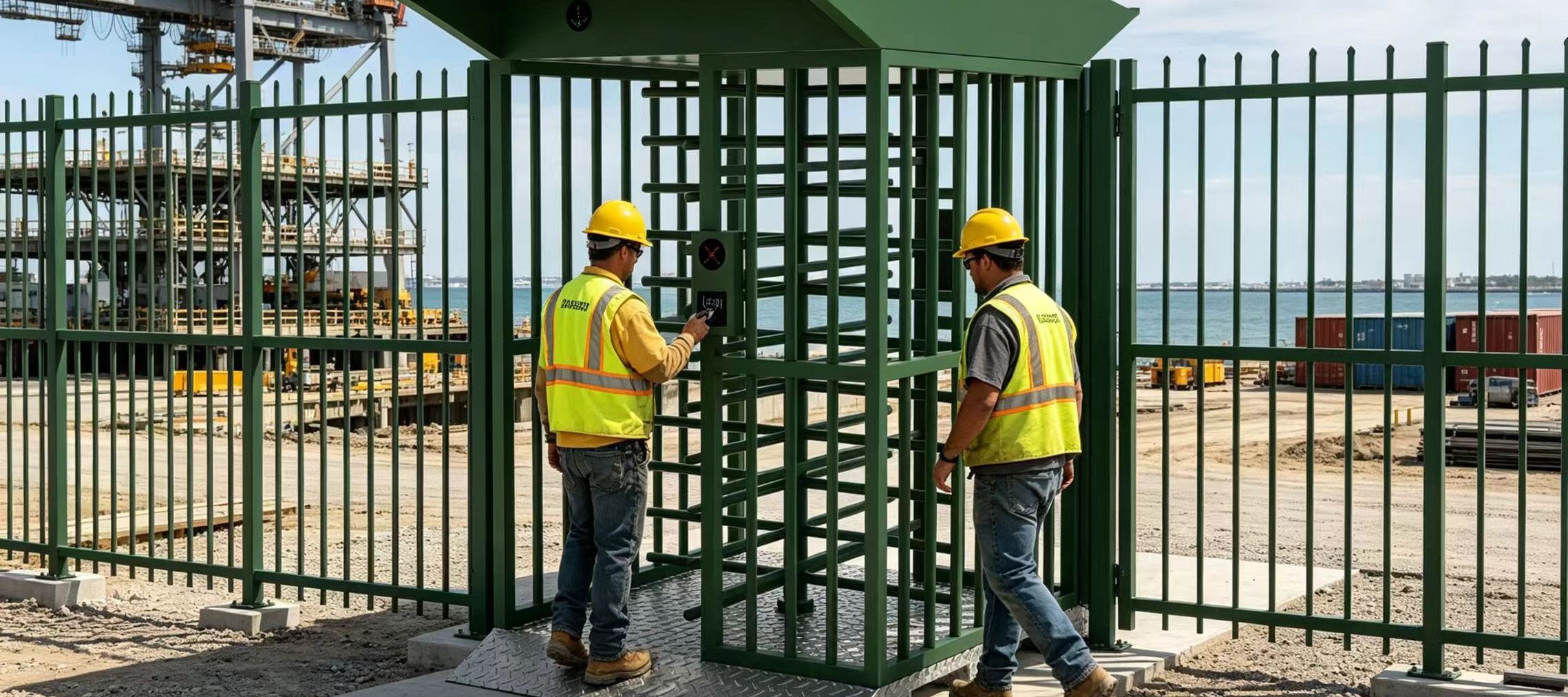
Construction sites are high-risk, high-movement environments with dozens or hundreds of workers, subcontractors, visitors, and delivery crews coming and going every day. Without controlled entry, site managers struggle to know exactly who is on site, verify safety training status, prevent theft of materials, and prove compliance during audits. Construction site turnstiles are purpose-built heavy-duty pedestrian access control turnstile gates designed to solve these pain points. Unlike standard office turnstiles, they are engineered for dust, rain, mud, impact, and 24/7 outdoor use, while enforcing one-person-per-passage rules and logging every entry and exit event.
If you are a general contractor, site manager, safety officer, or procurement buyer, you are likely researching construction site turnstiles to answer practical questions: Which type works for my jobsite? Can they run offline? Do they integrate with induction and safety training records? How do they stop tailgating and buddy punching? What are the emergency exit rules? This guide covers everything you need to evaluate, select, and deploy turnstiles for construction site access control.
What are construction site turnstiles?
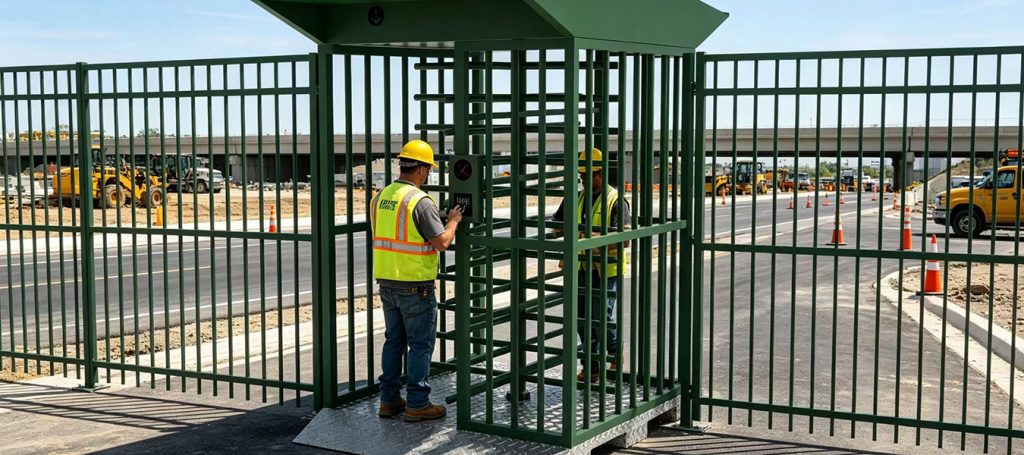
Construction site turnstiles are rugged pedestrian barriers that only release passage after valid credential verification, allowing one person through at a time. Common variants include tripod turnstiles, full-height turnstiles, half-height waist-high turnstiles, and speed swing gates for wheelchair and buggy access. They pair with readers such as RFID cards, QR codes, facial recognition, fingerprint scanners, or mobile phone credentials.
Good construction-grade models use stainless steel or galvanized frames, IP54 / IP65 weatherproof electronics, anti-pinch protection, and optional UPS battery backup for power outages. Many also support fire alarm linkage, which automatically unlocks the lane for emergency evacuation when an alarm triggers.
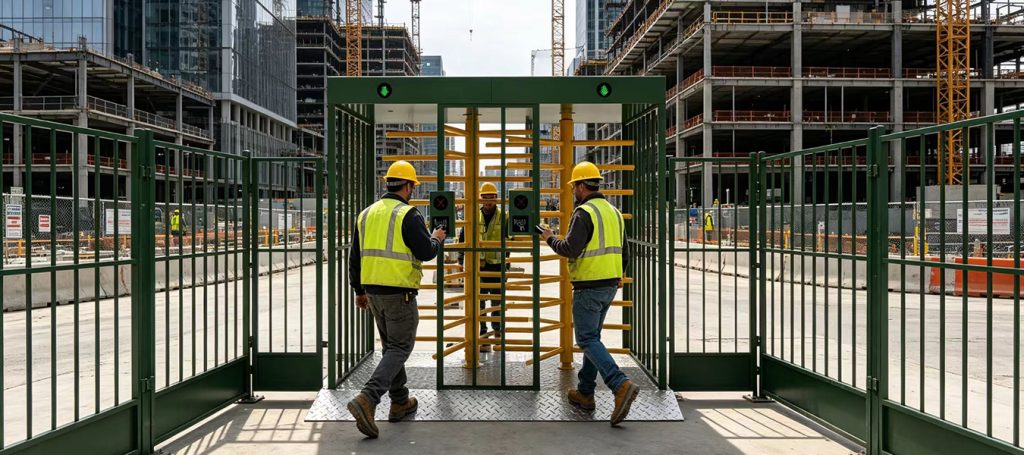
Why use construction site turnstiles?
- Prevent unauthorized entry, trespassing and material theft Open gates are easy targets for vandals, trespassers, and thieves looking for copper, tools, and building materials. Construction site turnstiles create a physical barrier: only people with valid, active credentials can enter. Full-height turnstiles add extra protection because they cannot be climbed over or crawled under easily, which is ideal for remote sites or high-value material yards.
- Stop tailgating and buddy punching Tailgating — one worker slipping in right behind another — is the biggest flaw of simple sign-in sheets or guard-only checkpoints. Construction site turnstiles use infrared sensors and mechanical rotation to enforce one person per entry. The system also blocks buddy punching: if a worker’s card is used by someone else, integrated biometrics or facial recognition can reject access and flag the incident for managers.
- Real-time workforce tracking and headcount Every entry and exit is timestamped and saved to an audit log. Managers can instantly see who is on site, how many people are present, and which subcontractor crews are inside. This is critical in emergencies such as fire, collapse, or storm evacuation, so rescue teams know exactly who may still be on site. The same data feeds attendance reports for payroll and subcontractor billing, replacing unreliable paper sign-in books.
- Enforce safety and induction compliance Modern construction turnstile systems connect to workforce management databases. Access can be automatically denied if a worker’s site induction, safety ticket, tool training, or medical certificate is expired. Workers cannot enter until their competency records are up to date. This reduces safety incidents and helps contractors pass local regulator audits for construction workplace safety rules.
- Improve site productivity and accountability Manual sign-in and guard checkpoints create long queues at shift change. Construction site turnstiles speed up entry and remove manual logging work for security staff. The attendance data also reduces time theft and disputes over shift hours, helping project managers track crew availability and schedule work more accurately.
- Lower liability and support insurance requirements If an unauthorised person gets hurt on your site, the contractor faces major liability. Turnstiles with clear audit trails prove you have a formal access control policy. Many insurers and main contractors now require documented site access records as a condition of working on the project.
- Flexible visitor and delivery management Turnstile systems can support temporary QR codes or one-time visitor credentials for clients, inspectors, and delivery drivers. Visitors cannot enter without a pre-approved pass, and all visitor movement is logged separately from permanent workers.
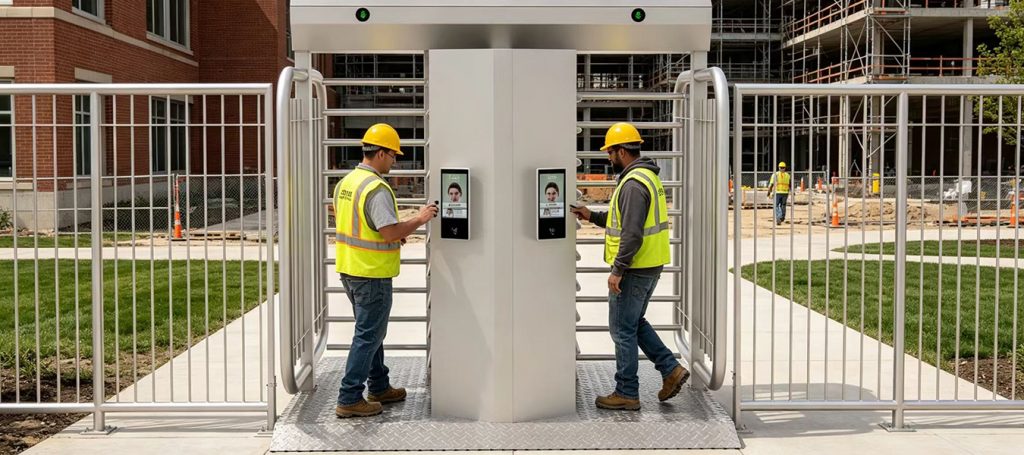
Common types of construction site turnstiles
- Full-height construction turnstiles: Highest security, climb-proof, best for remote sites, material yards, and perimeter entry. Slower throughput, very anti-tailgate.
- Tripod turnstiles: Most popular for construction. Balanced cost, durability, and throughput. Suitable for main worker entrances; outdoor-rated models available.
- Half-height / waist-high turnstiles: Lower cost, faster flow, but easy to jump over. Better for internal zones or low-risk secondary gates, not perimeter security.
- Speed gates/access swing barriers turnstile: Fast throughput, wide lanes, suitable for wheelchairs, trolleys and bikes. Often paired with full-height lanes for mixed access.
Key selection factors: peak shift traffic, security level, outdoor exposure, accessibility rules, emergency egress requirements, and whether you need portable rental units for temporary jobsites.
Frequently Asked Questions (FAQ)
Q1: Can construction site turnstiles work offline without internet?
A: Yes. Good construction access controllers store credential data locally on the turnstile. They continue verifying access and logging entries when the internet drops, then sync logs once connectivity returns. UPS battery backup is recommended for power cuts.
Q2: Which authentication method is best for construction workers?
A: RFID cards or QR codes are low-cost and simple. Facial recognition works well for reducing buddy punching, but choose dustproof, sunlight-resistant cameras. Fingerprint readers can struggle with dirty, wet hands on site. Most systems support mixed credential types.
Q3: Are construction site turnstiles compliant with emergency exit codes?
A: They must be fire-alarm integrated. On fire signal, the turnstile must release to free passage. Never lock emergency routes. Many sites combine controlled turnstile lanes with separate emergency swing gates for evacuation.
Q4: How many turnstile lanes do I need for a construction site?
A: Tripod turnstiles handle roughly 20–25 people per minute. Full-height units are slower, around 10–15 per minute. Calculate based on peak shift arrival window. Most contractors aim to clear the whole crew within 10–15 minutes at shift change, and separate entry lanes from exit lanes for busy sites.
Q5: Can turnstiles check if workers have valid safety inductions?
A: Yes, when integrated with workforce management software. The system checks expiry dates of inductions, white cards, PPE training, and medicals before unlocking. If expired, the turnstile denies entry and alerts the safety team.
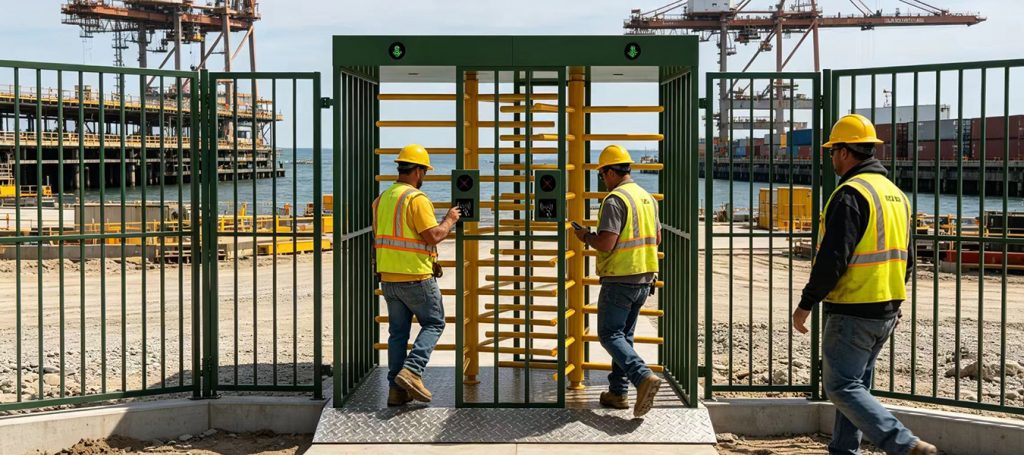
Q6: Can I install a normal indoor turnstile outside on a construction site?
A: Not recommended. Indoor models lack waterproofing, dust protection and UV resistance. Construction site turnstiles need at least IP54, preferably IP65 rated electronics, stainless steel frames and anti-corrosion treatment for outdoor jobsites.
Q7: Can construction site turnstiles be rented for temporary projects?
A: Many suppliers offer portable, pre-wired construction turnstile pods for short-term projects. These do not require permanent concrete foundations and can be moved when the site phase changes.
Q8: Do turnstiles stop tailgating completely?
A: Full-height turnstiles are the most effective against tailgating. Tripod and half-height models rely on infrared detection. Anti-tailgating sensors greatly reduce risk, but they work best as part of a layered system, sometimes supported by CCTV or a guard during peak hours.
Q9: What maintenance do construction site turnstiles need?
A: Inspect bearings, arms, sensors, readers and seals every 3–6 months. Clean camera lenses and card readers regularly from dust and mud. Lubricate moving parts and check battery health for UPS units. Outdoor units need more frequent maintenance than indoor ones.
Q10: Can turnstile data connect to payroll or construction project software?
A: Most modern construction access platforms support API, TCP/IP or RS485 integration to export attendance logs to payroll, HR, site management and BIM/project tracking tools.
Conclusion
A construction site turnstile is not simply a turnstile gate with a rotor. It is the physical point where access policy, safety compliance, workforce accountability, and operational throughput meet. The projects that get it right tend to start with the problem they need to solve—uncontrolled entry, compliance evidence, payroll integrity, emergency headcount, or queue time—and then choose the type, lane count, credential technology, and deployment method around that. The projects that regret it tend to start with a unit price and discover the rest later.
If the site moves, buy or hire for mobility. If the turnstile gate is unmanned, specify a full-height turnstile. If the audit trail matters—and on a regulated project it almost always does—make sure the reader, the turnstile controller, and the software produce a record that survives scrutiny.