
Supermarket turnstiles are specialized access control management devices for retail scenes, with the core function of one-way traffic guidance – only entry at the entrance and only exit at the exit, physically eliminating reverse flow of people. This is completely different from the access control logic of “identity verification before release” in office buildings and residential areas. The application of intelligent security turnstile gates in unmanned supermarkets or large supermarkets is not about “preventing people”, but about “directing traffic” – using physical means to completely separate the entrance and exit, allowing shopping carts to pass smoothly while blocking reverse flow outside the door. This is completely different from the logic of “identity verification before release” in office buildings or residential areas.
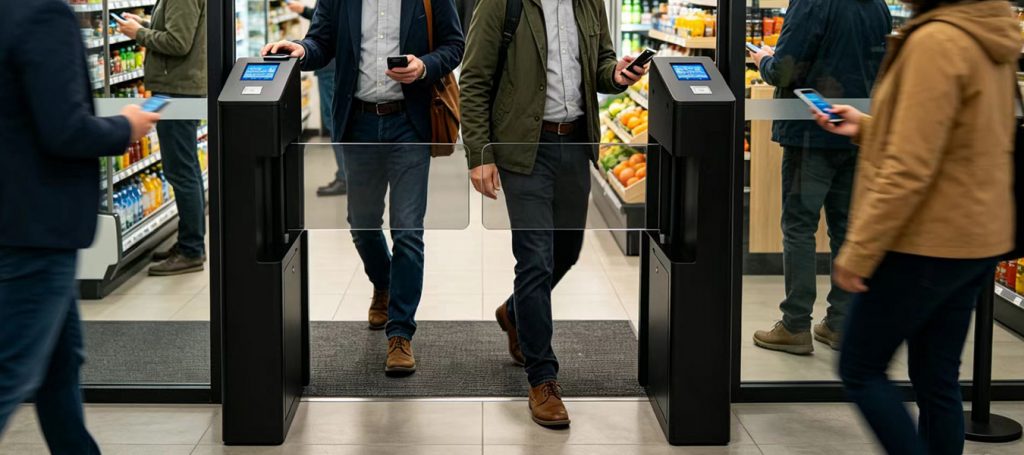
What are supermarket turnstiles: the essential difference from a regular swing turnstile
Supermarket turnstiles are access control management devices specifically designed for retail scenarios. Through one-way traffic control and wide channel design, they solve the core pain points of entrance crowd control, shopping cart access, and anti-theft management.
There are three rigid requirements for swing turnstiles in supermarket scenarios:
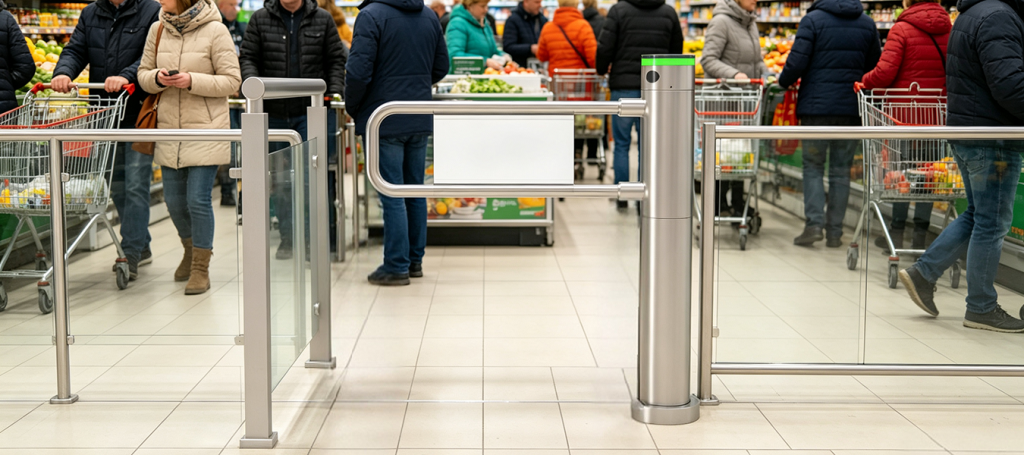
Firstly, the shopping cart must be passable. The traditional tripod turnstile gate channel width is usually less than 600mm, making it impossible for shopping carts to pass through. The width of the supermarket entrance turnstile gate channel is generally 600- 900 mm, and the customized wide channel can reach 950mm or more, with no pressure for carts to pass through.
Secondly, it has strong resistance to light interference. The entrance lighting of the supermarket is complex – spotlights, natural light, and promotional light boxes interweave. Infrared radiation is prone to misjudgment under strong light, resulting in “closing the supermarket turnstiles before the person arrives” or “not opening the gate when the car arrives”. Modern supermarket turnstiles commonly use brushless DC servo motors with 6 or more pairs of infrared sensors, and some solutions introduce radar detection to enhance light resistance.
Thirdly, the traffic efficiency should match the passenger flow. During peak hours, there is a high volume of foot traffic at the entrance of the supermarket. The turnstile must support flexible switching between normally open mode (40 people/minute or more) and normally closed mode (25-30 people/minute) to avoid the entrance becoming a bottleneck.
Why do we need to install supermarket turnstiles?
The typical chaos at the entrance of a supermarket is: the entrance and exit are mixed together, people pushing shopping carts want to enter, people carrying bags want to enter, two streams of people clash, and the entrance is blocked into a ball. Customers hesitate, look for doors, and give way at the entrance, and the entire flow is not smooth from the first step.
The swing turnstile barrier gate solves exactly this problem. It uses a one-way traffic logic, forcing only entry and exit at the entrance, naturally diverting the flow of people, and no longer “fighting” at the entrance.
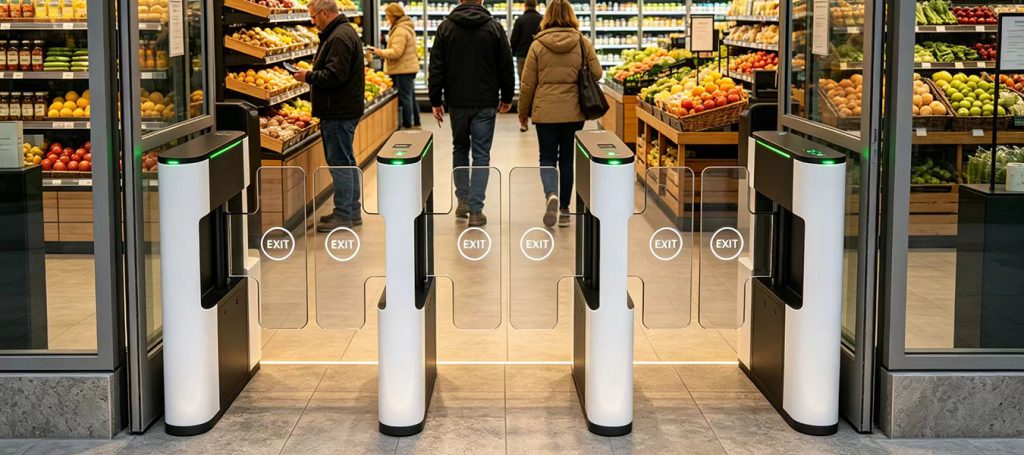
Another key pain point is the shopping cart. Traditional tripod turnstile gates or narrow access control turnstile gates make it impossible for shopping carts to pass through, and customers have to turn sideways and pick up their cars, resulting in a very poor experience. The width of the supermarket turnstiles channel can reach 900mm or even 1000mm or more, and the shopping cart can be pushed directly without any pressure.
Technical configuration of supermarket turnstile
Induction method: Radar is superior to infrared. The lighting in the supermarket environment is complex, and spotlights and sunlight can easily interfere with infrared radiation, leading to misjudgment or “collision”. Microwave radar is not affected by light, with a detection angle of up to 120 °. It can detect customers and shopping carts in advance from 0.8-1.2 meters away, achieving a smooth experience of “people to the gate opening, car to the gate opening”.
Unidirectional locking: Physical anti-reverse. The system is set to only allow forward traffic. Once the radar detects someone attempting to enter in the opposite direction from the exit, the supermarket turnstiles will immediately lock and trigger an audible and visual alarm, physically preventing reverse flow.
Channel width and traffic speed. The width of the supermarket entrance turnstile passage is usually 900-1000 mm, which can accommodate single-person carts or two people running in parallel. The traffic speed can reach 40 people/minute in normally open mode, and about 25-30 people/minute in normally closed mode.
Security protection. The swing arm adopts a flexible anti-pinch design, which will automatically stop and rebound when it touches a person or shopping cart, with a force controlled within 2Kg, making it friendly to the elderly and children.
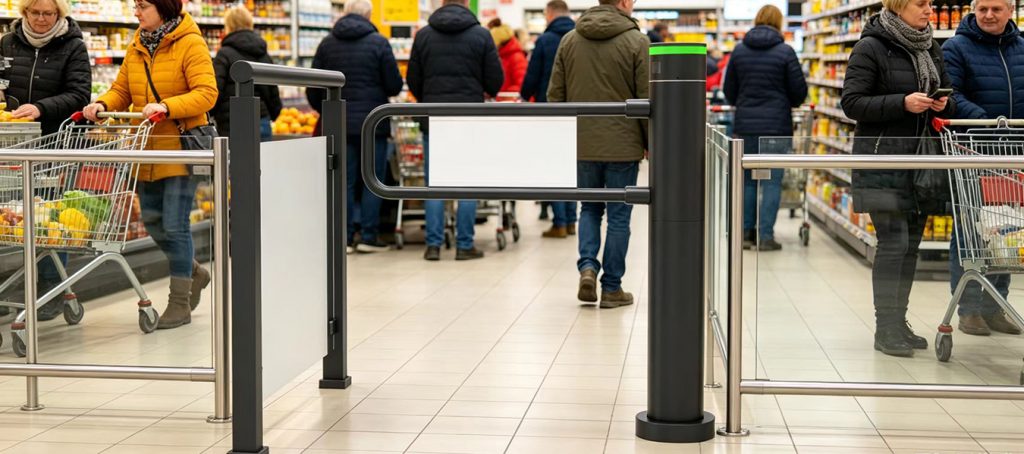
The integration trend with anti-theft systems
Supermarket turnstiles are evolving from simple “access devices” to “anti-theft nodes”. There are currently three main technological paths:
Integrated sound and magnetic detection. The patent scheme directly installs the acoustic magnetic detection equipment on the gate bracket. When the magnetic strip of the product is not demagnetized, the sound and light alarm is triggered, the supermarket turnstiles remain locked, and personnel cannot pass through; The gate will only be unblocked when all magnetic stripes are demagnetized.
RFID channel door. A channel reader based on ultra-high frequency RFID can automatically detect the direction of tag travel, accurately distinguish between “on-site” and “off-site”, and determine whether goods have been taken out without payment. The recognition speed can reach 1000 frames per second and supports sound and light alarms.
AI visual verification. By combining radar and camera monitoring of the rotating area, AI sensors verify every step from the entry of the product to the departure of the customer during checkout. Only after confirming that the product has been paid for, will the gate be released.
Integrated checkout solution for supermarket turnstiles
The “checkout-equipped supermarket turnstile gate” used in unmanned supermarkets is essentially not adding a barcode scanner to the supermarket turnstile gate, but integrating the settlement area with the gate channel: customers complete product identification and payment in the gate channel, and the supermarket turnstile is opened and released only after successful payment. There are currently three main technical paths for the implementation of the plan.
1. RFID settlement channel (closest to the form of “supermarket turnstiles integrated settlement”)
This is currently the most closely integrated solution with swing gates in unmanned supermarkets. The core idea is to directly embed the settlement area into the supermarket turnstiles channel, and customers will complete the settlement upon entering the channel.
Workflow: Customer enters the channel → RFID recognition device in the channel reads product tag information (name, price, number) → System generates payment code or automatic deduction → Payment is completed, and the exit gate is opened for release. The patent scheme specifies that the checkout area is equipped with a checkout entrance and an checkout exit, each with an automatic door. The exit door will only automatically open after payment is completed, and users cannot open the exit door themselves to leave.
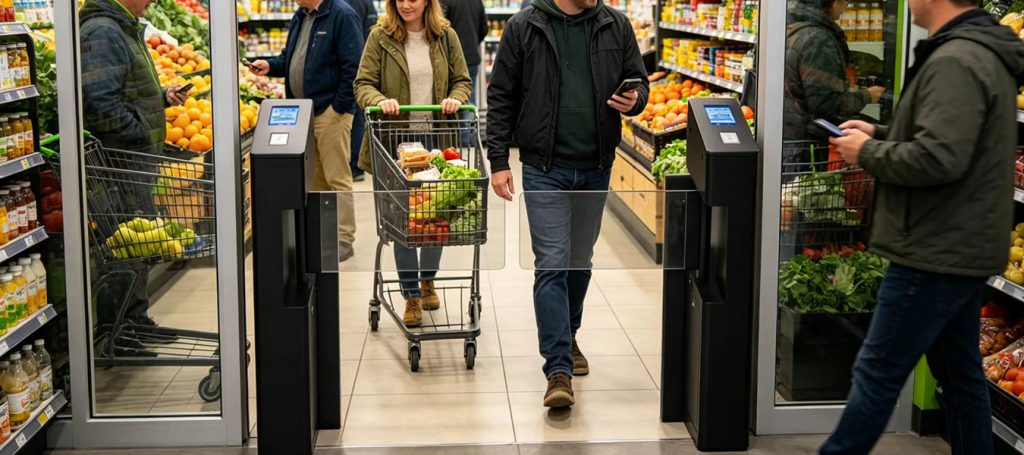
Key configuration:
RFID identifier: embedded in the inner wall of the channel to read product tag information
Monitoring equipment: Camera captures real-time footage of the checkout area, supports trajectory tracking and abnormal behavior analysis
Processor: the logical center that coordinates recognition, payment, and gate control
Anti-theft logic: The product label synchronously rewrites the anti-theft position during settlement. Sko Information’s solution adopts Impinj R2000 ultra-high frequency read-write chip, and the settlement counter completes tag anti-theft position rewriting while batch identifying goods, with a success rate of not less than 99.9%. Paid products will not be intercepted by access control when they leave the store.
Actual effect: The RFID checkout counter can read 10-50 items in a single batch in just 1-3 seconds, which is more than 40 times more efficient than traditional manual checkout. There is a plan to achieve anti-theft and settlement in one step, reducing the loss rate from 2.7% to 0.3%.
2. AI visual recognition settlement+gate linkage
Suitable for small unmanned stores with relatively concentrated product categories and few SKUs. The AI visual recognition platform is responsible for product recognition and pricing, while the supermarket turnstiles are responsible for ensuring “release only after payment”.
Workflow: The customer places the product at the AI checkout counter → The camera automatically recognizes the product and calculates the price → The customer scans the code/face to complete the payment → The system sends a release signal to the gate → The gate opens.
Technical configuration: The Tianbo AI visual recognition settlement table adopts dual AI cameras with a recognition accuracy of up to 99%. Products are recognized as soon as they are placed on the table, and pricing is completed in 2-3 seconds. For non-standard products such as baking and fresh produce, the recognition accuracy can reach 99.8%.
Applicable scenarios: community stores and fresh convenience stores with an area of 500-800 square meters. After Wal Mart Shenzhen Community Store introduced the AI visual checkout counter in the bakery area, the average queuing time was shortened from more than 5 minutes to less than 1 minute. A single device can replace a full-time cashier, and the overall human cost of the store was reduced by about 25%.
Limitations: The AI vision solution may have a misjudgment rate of over 15% when the product is obstructed, and manual review is required. Therefore, it is more suitable for scenarios where SKUs are streamlined and product forms are standardized.
3. Completely seamless passage (gates only serve as access control)
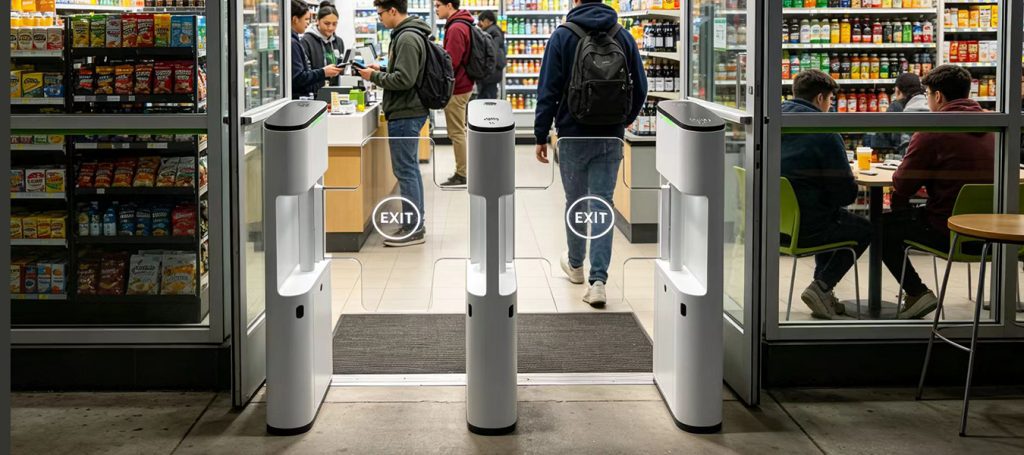
This is the most radical solution, where the supermarket turnstiles do not perform settlement functions and is only responsible for “opening the door after confirming payment”. Settlement is automatically completed by the system during the customer’s walking process.
Workflow: Customers swipe their credit card/face to enter → freely select products → directly proceed to the exit → the exit button triggers system verification → confirms that the bill has been automatically generated and deducted → the exit gate is opened.
Technical support: Amazon Just Walk Out technology combines AI and computer vision to track in real-time the items taken or put back by customers through a network of ceiling cameras and shelf weight sensors, automatically adding them to the virtual shopping cart and deducting payment when passing through the exit. This technology has been implemented in Gage Market on UBC campus in Canada, achieving 24-hour unmanned operation.
Core advantage: Complete disappearance of settlement actions, providing the smoothest customer experience. In terms of system architecture, the supermarket turnstiles only performs identity/payment method binding, while the exit gate only performs “release after deduction confirmation” and is not directly coupled with product identification.
Cost: The system has the highest complexity and requires deep coordination of camera networks, sensor shelves, and AI algorithms, resulting in significantly higher deployment costs than the first two solutions.
Integrated anti-theft detection solution for supermarket turnstiles
The core value that distinguishes supermarket turnstiles from ordinary access control turnstile gates is that they can be deeply integrated with anti-theft systems, forming an integrated node of “passage+anti-theft”. There are currently three mainstream solutions:
1. Acoustic magnetic detection integration (most mature)
Integrate the commonly used acoustic magnetic anti-theft door (EAS) for supermarket exits directly onto the side of the swing gate rack. When the magnetic strip of the product is not demagnetized, the sound magnetic device triggers an alarm, the control module keeps the blocking mechanism closed, and personnel cannot pass through; Only after detecting that all magnetic stripes have been demagnetized, will a signal be sent to unblock them.
Advantages: The cost of acoustic magnetic tags is extremely low, the technology is mature, and the amount of modification is small.
Limitations: It can only detect demagnetized magnetic strips, and is powerless for “demagnetized but unpaid” products.
2. RFID radio frequency detection (higher accuracy)
Embed RFID detection antennas on the side walls of the supermarket turnstile gate channel to read the anti-theft status of product tags. In the patented solution of an intelligent unmanned supermarket, the exit access control is equipped with a built-in buzzer, which automatically detects the demagnetization status of products labeled with RF passive tags. If not demagnetized, an alarm is triggered.
More complex systems use dual verification of the first exit gate and the second exit gate: the first gate interacts with the smart shopping cart through RFID to verify product scanning information and weighing data; The second gate will only be released after confirmation of payment completion.
Advantages: High detection accuracy, able to distinguish between “purchased” and “unauthorized taken out”, supports multi-channel cascading.
Limitations: RFID tags are required for products, and metal packaging and liquid products may experience signal interference.
3. AI vision+multi system linkage (strongest anti-theft)
The export is equipped with a weighing system, RFID, and camera for three-layer verification. Check whether the total weight of the items in the shopping cart matches the weight that has been scanned and entered using the weighing sensor; RFID confirms tag status; AI camera analyzes abnormal behavior (hiding goods, multiple people obstructing).
The practical data disclosed by Huawei Cloud Community shows that the mAP of SlowFast abnormal behavior detection reaches 0.421, the missed detection rate of export RFID+face secondary verification is<0.05%, and the theft rate has decreased from the industry average of 2.5% to 0.6%.
Typical application scenarios of supermarket turnstiles
Entrance to large supermarkets. The entrance channels of Wal Mart, RT Mart and other large supermarkets need to keep order under high passenger flow. The normally open mode of the supermarket turnstile gate, combined with radar sensing, allows customers to drive as soon as they approach, and the shopping cart is pushed directly past, eliminating congestion at the entrance.
Unmanned supermarkets/convenience stores. The supermarket turnstiles play a dual role of “settlement confirmation+anti-theft release”. After the customer completes the self-service settlement, the system sends a release signal and the gate opens. The RFID solution can achieve batch identification of 10-50 items in 1-3 seconds, which is tens of times more efficient than manual checkout.
Community fresh food supermarket. A community store with an area of 500-800 square meters, equipped with an AI visual settlement counter and linked supermarket turnstiles, can replace one cashier with a single device, reducing queue time from over 5 minutes to less than 1 minute and reducing labor costs by about 25%.
Selection suggestions and market trends
Choose a supermarket turnstile gate and focus on three things:
Consider channel requirements – shopping cart access is the bottom line, with a minimum channel width of 600mm and a recommended width of 900mm or more; If there is a demand for non motorized vehicles entering the store, choose the 950mm wide aisle model.
Looking at the requirements for anti-theft integration – for supermarkets that already have sound and magnetic anti-theft doors, choosing the sound and magnetic integrated swing brake requires the least amount of modification; The product has been labeled with RFID tags or planned to be labeled with RFID, and the RFID integration solution has the highest accuracy; Unmanned supermarkets or high loss categories, AI vision+multi gate linkage is worth investing in.
Judging by the level of intelligence – modern supermarket turnstiles have been upgraded from simple blocking devices to “smart traffic nodes”, supporting functions such as facial recognition, QR codes, ticketing linkage, and passenger flow statistics. In 2025, the market size of China’s channel gate will continue to expand, with a compound annual growth rate of over 10%. Intelligence and multifunctional integration are the core directions.
When choosing a swing turnstile for a supermarket, three key factors should be considered: the width of the channel should be able to pass through the shopping cart (starting at 900mm), the sensing mode should be radar instead of infrared (anti-light interference), and the control mode must be one-way locking (anti-reverse). If the supermarket has a self-checkout area or high-loss categories, a swing turnstile solution with integrated anti-theft detection can be considered. When selecting, it is recommended to prioritize suppliers with experience in retail scenarios rather than general turnstile manufacturers.