
When you plan to deploy pedestrian access control at exposed entry points, an indoor turnstile will quickly fail. Rain, UV rays, salt spray, freezing winters or scorching summers can cause rust, short circuits, sensor malfunctions and motor breakdowns. Many buyers search for outdoor turnstiles because they need reliable, low-maintenance access turnstile gates that can survive harsh outdoor conditions, not just a cosmetic stainless steel barrier.
This guide walks through the core selection criteria, common pitfalls, material comparison, IP rating explanation, extreme weather solutions and practical project considerations that most specifiers, facility managers and integrators look for when sourcing outdoor turnstiles.
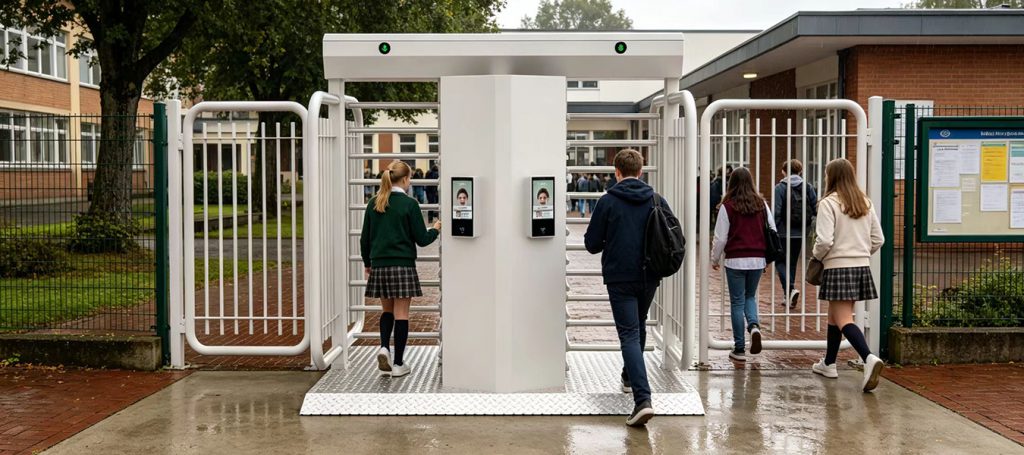
1. Anti-corrosion Performance: The Foundation of Outdoor Turnstile
Corrosion is the #1 cause of premature outdoor turnstile failure. Humidity, acid rain, coastal salt air, industrial chemical dust will attack cabinet welds, fasteners and metal surfaces. Material selection directly determines service life.
SUS304 Stainless Steel
The standard option for most outdoor sites away from the coast. It offers good resistance to rain and ordinary humidity. It is widely used for construction sites, stadiums, park entrances and factory gates. But it will still develop rust spots under long-term salt spray exposure near the sea. Surface treatments like wire drawing, anti-fingerprint coating or fluorocarbon spraying can further improve UV and corrosion resistance.
SUS316 Stainless Steel
The preferred material for coastal, marine, port and chemical industrial areas. Molybdenum in SUS316 greatly improves chloride resistance, resisting salt spray corrosion. For locations within 1km from the coastline, SUS316 is strongly recommended even with a canopy.
Other anti-corrosion details buyers should check:
- Fully welded and passivated cabinet seams, not just bolted assembly
- Marine-grade coating for non-stainless components
- Stainless steel screws and fasteners, avoid carbon steel hardware
- Salt spray test report: verify hours of salt resistance before purchase
2. IP Rating Explained for Outdoor Turnstile Electronics
IP (Ingress Protection) rating defines how well the electronic housing blocks dust and water. Many customers misunderstand: a stainless steel cabinet does not equal waterproof electronics. The metal structure prevents rust, while IP rating protects circuit boards, readers, motors and sensors.
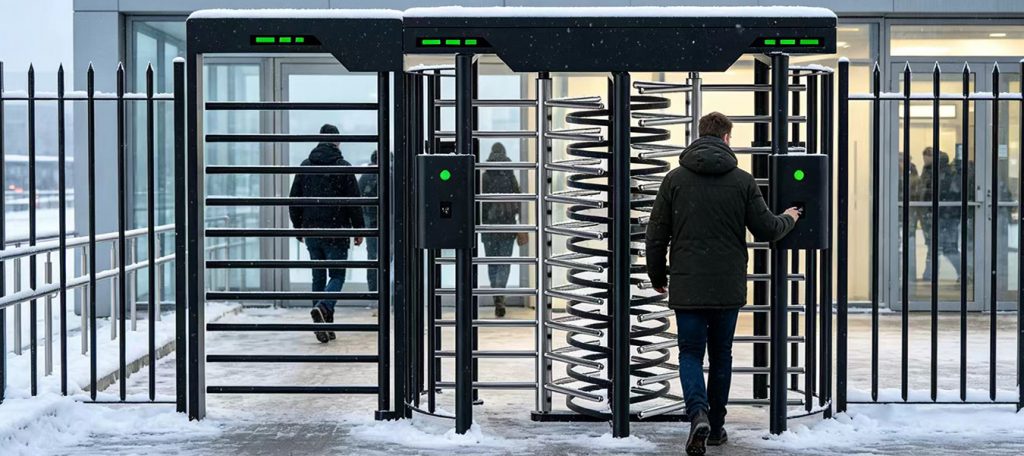
- IP54: Semi-outdoor / canopy covered sites. Dust protected against limited ingress; splash-proof from any direction. Not suitable for fully exposed open-air locations with direct heavy rain.
- IP65: Minimum standard for fully exposed outdoor turnstiles. Dust-tight; protected against low-pressure water jets from all directions. Handles heavy rain, outdoor cleaning water spray. Most outdoor tripod, full height turnstiles adopt IP65 for control boxes and reader modules.
- IP66 / IP67: For heavy rain, flood-prone or industrial wash-down sites. IP67 can resist temporary immersion in shallow water. Higher IP usually raises cost and maintenance requirements.
Important note: The IP rating must apply to the control enclosure, reader and sensor modules separately. Some suppliers only give IP rating for the cabinet shell, while the biometric or QR reader remains indoor-grade. Always confirm the IP rating of every electronic component.
3. Extreme Weather Solutions for Outdoor Turnstiles
Different climates bring unique challenges. A turnstile working well in tropical areas may freeze and jam in cold regions.
Hot & High UV Climate (Middle East, desert areas)
Long-time strong sunlight causes plastic aging, screen fading, overheating of control boards. Solutions:
- UV-resistant coating and tempered glass for readers
- Heat dissipation design, optional cabinet ventilation
- Wide operating temperature range up to +60°C ~ +70°C
- Avoid cheap plastic parts that crack under UV
Cold & Freezing Climate (Northern regions, heavy snow)
Low temperature may slow motor response, condensate inside the cabinet, ice block rotation mechanism. Solutions:
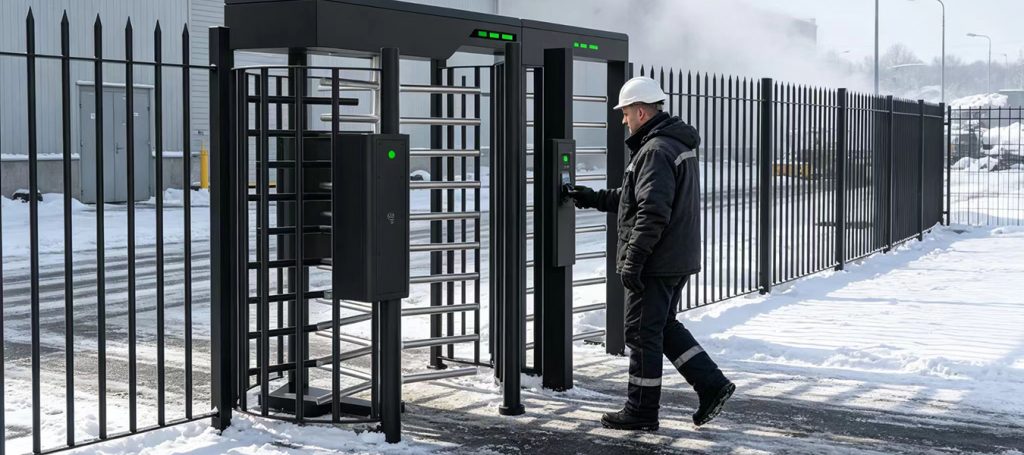
- Built-in heater and temperature sensor inside the control box
- Low-temperature brushless motor, rated to -30°C
- Anti-condensation design, drain holes for melting snow water
- Snow-proof foundation and sloped ground to avoid water accumulation around the base
Coastal & High Salt Air Environment
Salt fog penetrates tiny gaps and causes hidden corrosion inside motors and circuit boards. Solutions:
- SUS316 cabinet and all exposed metal parts
- Sealed cable glands, anti-corrosion coating
- Regular maintenance schedule to clean salt deposits
Heavy Rain & Flood Risk
Standing water at the foundation will damage the bottom of the cabinet and wiring. Solutions:
- Raised concrete foundation with drainage slope
- External cable waterproof conduit, proper cable entry sealing
- IP66/IP67 optional for flood-prone sites
4. Turnstile Type Selection for Outdoor Use
Not all turnstile models are designed for fully exposed outdoor installation.
- Full height turnstile: Best for high security outdoor sites, prisons, industrial perimeter, ports. Robust structure, strong anti-climb, suitable for fully exposed outdoor.
- Tripod turnstile: Most popular outdoor option, cost-effective for construction sites, factory entrances, stadiums. SUS304/SUS316 + IP65 recommended.
- Outdoor swing barrier: Can be used outdoors, but a canopy is highly recommended for biometric readers.
- Speed gates / flap barriers: Standard indoor models cannot be used outdoors. Only specially customized waterproof versions work, usually better for covered semi-outdoor areas.
5. Additional Key Factors Buyers Evaluate
- Operating temperature range: confirm the whole unit’s working range, not only motor specs
- Access control compatibility: RFID, QR code, facial recognition, fingerprint, ticketing system, dry contact / TCP/IP / RS485 integration
- Anti-tailgating function: infrared or radar detection for outdoor strong light and rain interference
- Power supply and lightning protection: surge protection for outdoor lightning-prone areas
- Foundation and installation requirement: concrete base, drainage, cable routing, ground leveling
- Maintenance: spare parts availability, easy access to internal components, service support
- Certifications: CE, FCC, RoHS, test reports for salt spray and IP testing
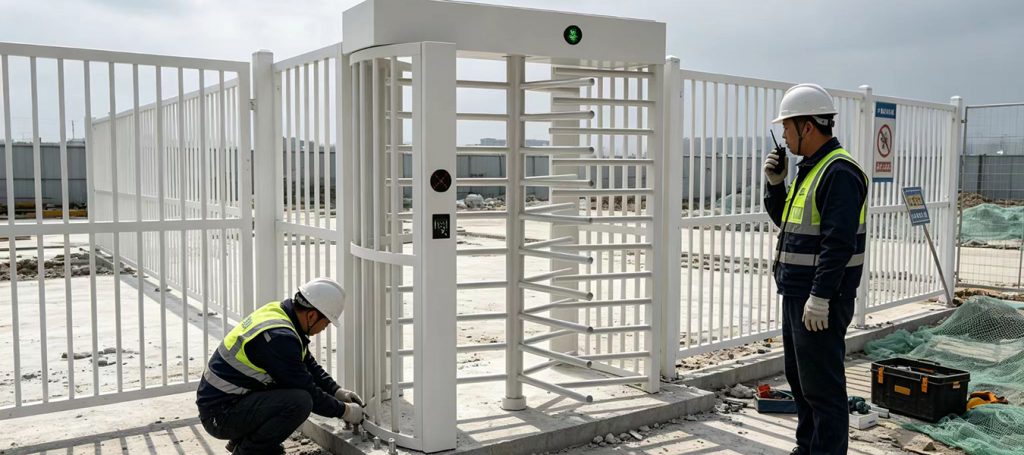
What are outdoor turnstiles?
Outdoor turnstiles are heavy-duty access control barrier gates designed specifically for open-air, exposed environments to regulate pedestrian entry and exit. Unlike indoor turnstiles built for controlled climate spaces, outdoor models are engineered to resist rain, UV sunlight, humidity, dust, temperature swings, and even salt spray. They authenticate users, restrict unauthorized access, prevent tailgating, and track visitor flow at public and commercial outdoor entry points.
Core working principle
Outdoor turnstiles use mechanical or servo motor-driven barrier mechanisms (tripod turnstile, full-height barrier turnstile, swing barrier security gate, sliding gates) to allow only one person to pass per valid credential. Access can be granted via RFID cards, QR codes, facial recognition, fingerprint readers, or remote control. Once verified, the barrier unlocks for a single passage then automatically re-locks.
Main types of outdoor turnstiles
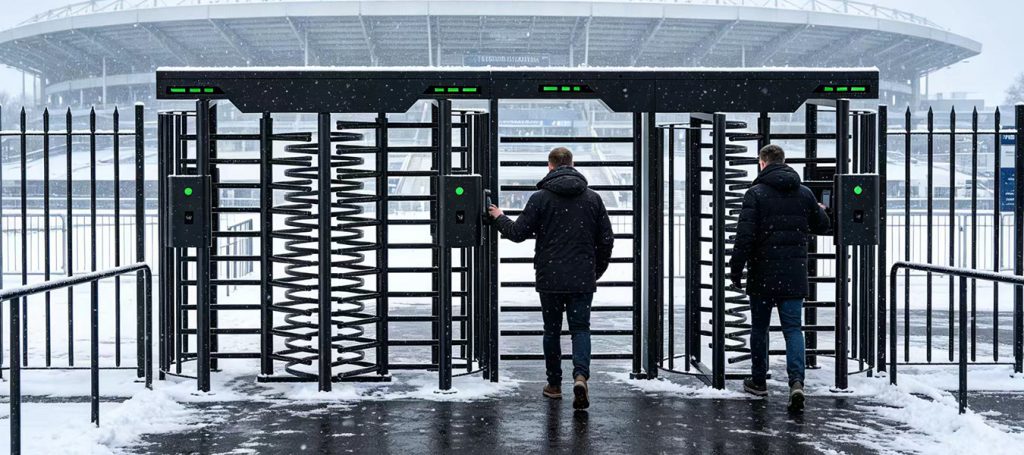
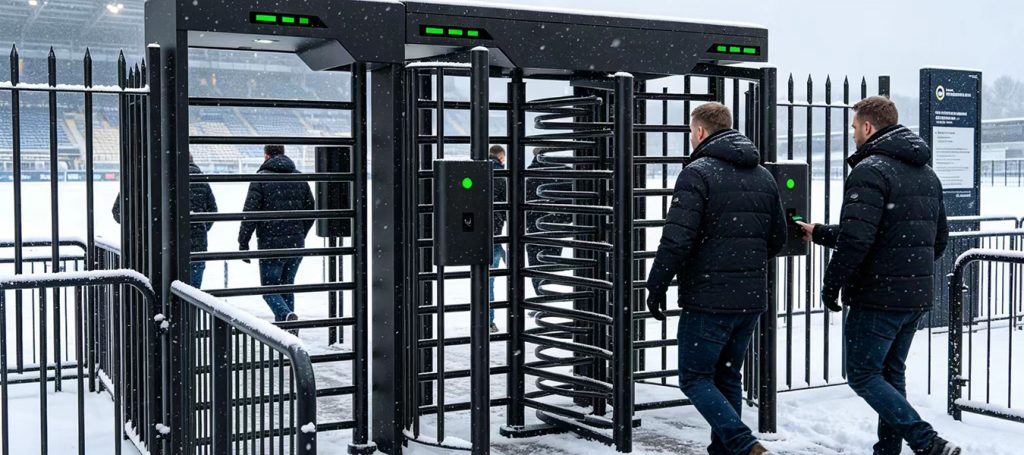
- Outdoor tripod turnstiles (3-roller turnstiles) The most widely used outdoor option. Robust, cost-effective, excellent anti-tailgating performance. Common for stadiums, construction sites, parks, public transport outdoor gates.
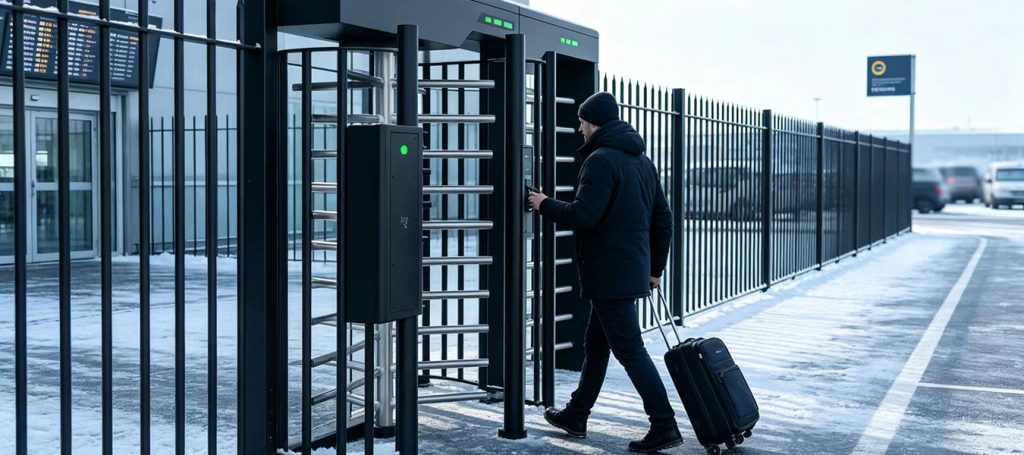
- Full height outdoor turnstiles Tall, fully enclosed barriers, near-impossible to climb over. Highest security level. Ideal for prisons, industrial yards, port facilities, high-security perimeter access.
- Outdoor swing turnstiles (swing barriers) Smooth, wide passage lanes, suitable for wheelchairs, luggage, bicycles. Popular for residential communities, resorts, building outdoor main entrances.
- Outdoor sliding turnstiles Sleek design, space-saving. Used for premium commercial outdoor gateways and high-end residential compounds.
Key design features that separate them from indoor turnstiles
- Anti-corrosion housing: 304 or 316 stainless steel, powder-coated steel or aluminum alloy, resisting rust and chemical corrosion.
- Certified IP ingress protection: IP54, IP65 or IP67 to block dust and rainwater.
- Extreme weather adaptation: Optional built-in thermostat heaters, dehumidification vents to stop internal condensation in cold or humid climates.
- UV-resistant components: Seals, polycarbonate wings and plastic parts prevent yellowing and cracking under long sun exposure.
- Wide temperature operating range: Can work reliably in both hot tropical heat and freezing sub-zero winter temperatures.
Common application scenarios
- Stadiums, amusement parks, public parks
- Construction sites, industrial plants, ports
- Outdoor parking lots, residential community perimeter gates
- Beach resorts, coastal tourist attractions
- Outdoor public transit stations, university campus external entrances
FAQ
Q1: Can I install an indoor turnstile outside with a simple canopy?
A: Not recommended. Indoor turnstiles use low IP electronics, no UV protection and ordinary metal hardware. Even with a roof, humidity, dew and temperature cycling will gradually damage circuit boards and cause rust. You need semi-outdoor IP54 rated models at minimum.
Q2: What IP rating do I need for fully exposed outdoor turnstile?
A: IP65 is the industry minimum standard for fully exposed outdoor locations. IP66 or IP67 can be selected for heavy rain or flood risk areas. Remember to check the IP rating of readers and sensors, not only the main cabinet.
Q3: SUS304 vs SUS316 outdoor turnstile, how to choose?
A: SUS304 fits inland outdoor sites with normal rain and humidity. SUS316 is mandatory for coastal, marine, port and chemical sites with salt air. SUS316 has much better chloride corrosion resistance, but higher cost.
Q4: Can outdoor turnstiles work in heavy snow and sub-zero temperatures?
A: Yes, but you need the cold weather package: built-in heater, temperature controller, low-temperature brushless motor, anti-condensation sealing and drainage design. Confirm the operating temperature range before ordering.
Q5: Will sunlight affect facial recognition readers on outdoor turnstiles?
A: Yes. Strong direct sunlight may cause overexposure and recognition failure. Select outdoor-rated biometric readers with anti-glare design, or install a canopy to shield the reader module.
Q6: What maintenance does an outdoor turnstile need in a coastal environment?
A: Regular inspection of sealing gaskets, cable glands, drainage holes. Clean salt or dust deposits on surface. Check heater function before winter, inspect motor and sensor performance quarterly. Coastal sites need more frequent maintenance.
Q7: Can outdoor turnstiles integrate with my existing access control or ticketing system?
A: Most outdoor turnstiles support dry contact relay, TCP/IP and RS485 interface. Confirm communication protocol with your integrator before purchase to avoid compatibility issues.
Q8: Is anti-tailgating reliable on outdoor turnstiles in rain or fog?
A: Ordinary infrared sensors may be disturbed by heavy rain or fog. For harsh outdoor sites, choose radar or enhanced multi-beam infrared anti-tailgating modules optimized for outdoor weather interference.
Q9: Can outdoor turnstiles be installed in areas with high humidity?
Yes, outdoor turnstiles can be deployed in high-humidity locations, but only if you select the correct hardware, materials and protective design.
Q10: What are the common materials used in outdoor turnstiles?
For most general outdoor projects, 304 stainless steel is the default pick. If your site is near the ocean or has persistent high humidity, upgrade to 316 stainless steel. Avoid ordinary carbon steel for high-corrosion locations unless full protective coating maintenance is guaranteed.
Q11: Is IP65 enough for an uncovered outdoor turnstile?
For most exposed urban and inland outdoor deployments, IP65 is the correct baseline: totally dust-tight and protected against low-pressure water jets from any direction. It is not sufficient on its own for coastal sites, because IP ratings address water and dust ingress, not chloride-induced corrosion. Coastal installations require IP65 together with 316 stainless steel. For heavy rain, pressure-washing, or direct coastal spray, IP66 provides a higher liquid-protection margin.
Q12: Does a higher IP rating mean the turnstile is fully weatherproof?
No. An IP rating certifies the enclosure’s resistance to dust and water under defined test conditions. It does not certify resistance to salt-induced corrosion, UV degradation, freeze-thaw cycling, or wind-driven sand. A unit can be IP65 and still fail in a coastal environment if the stainless grade and finish are not appropriate. Weatherproofing is the combination of IP rating, material grade, finish system, temperature strategy, drainage, and installation quality—no single number covers all of them.