
What Are Gym Turnstiles and Why Does Your Gym Need Them?
Gym turnstiles are intelligent access control gates specially designed for fitness centers, health clubs, boutique studios and 24-hour self-service gyms. They validate member credentials and enforce one-person-per-entry rules to secure your gym entrance.
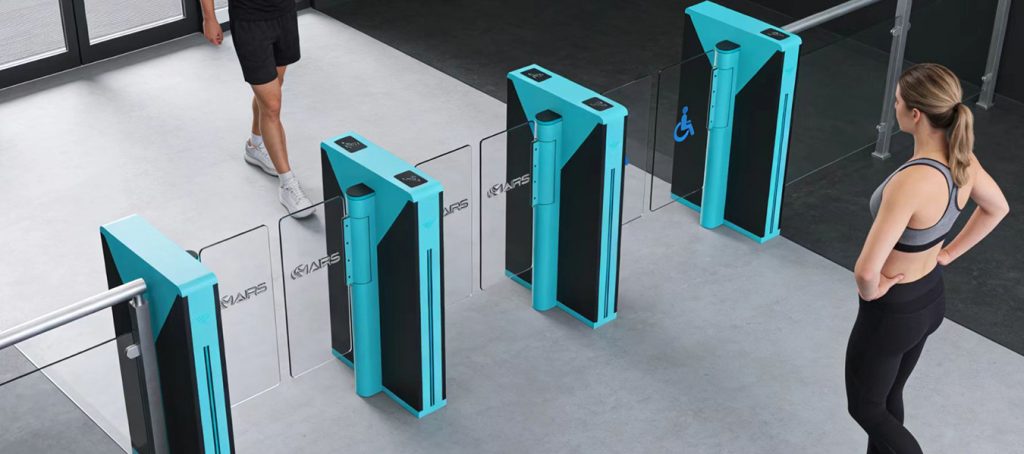
If you run a gym, you have likely encountered these frustrating scenarios:
- Card sharing and buddy punching: A member lends their access card or QR code to a friend, and that friend gets a free workout at your expense. With 10 unauthorized users paying a €40 monthly fee, a gym loses approximately €4,800 in potential annual revenue.
- Tailgating: Someone slips through the entry point right behind a paying member without scanning anything.
- High front desk labor costs: Staffing a reception desk during all operating hours, especially for 24/7 facilities, is expensive and unsustainable.
- Inaccurate member data: Without automated tracking, you cannot reliably know who visited, when they came, or how busy the gym was at any given time.
Gym turnstiles solve all of these problems by automating access control, verifying each member’s identity, and recording every entry in real time.
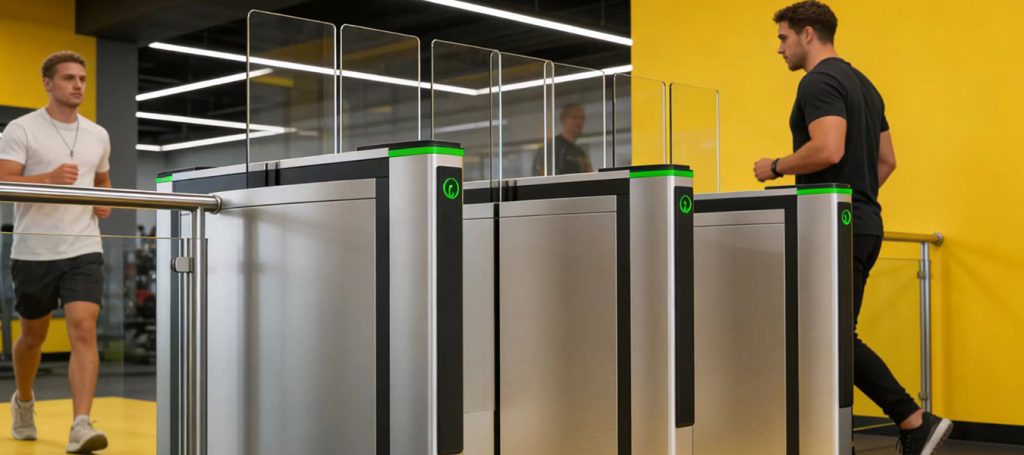
Main Benefits of Gym Turnstiles
Stop tailgating & unauthorized entry
Tailgating is one of the biggest revenue drains for gyms. A person sneaking in right behind a valid member wastes your gym resources and loses membership income. Modern gym turnstiles use infrared and optical sensors to detect tailgating behaviour, trigger alerts and block passage, so only one person can pass after one valid credential verification. This stops card sharing, guest sneaking and unauthorised entry effectively.
Reduce front desk labor cost
With gym turnstiles, your gym no longer needs staff to manually verify every member at the entrance. You can cut down front desk headcount, or even run unattended 24-hour gyms. Staff can focus on member service, cleaning and fitness coaching instead of repetitive identity checks.
Seamless member access: RFID, QR code, facial recognition
Today’s gym turnstiles support multiple access methods. Members can use RFID membership wristbands or cards, mobile app QR codes, or facial recognition for fast, contactless entry. You can mix access modes for different member groups, delivering a frictionless check-in experience.
Real-time traffic data & attendance reporting
The turnstile system logs every entry event and feeds data into your gym management platform. You get real-time foot traffic tracking, daily attendance reports, peak hour analytics, and member visit history. This data helps you make better decisions on staffing, class scheduling and marketing.
Improve member experience, fast entry during peak hours
During early morning and evening rush hours, long queues at reception frustrate members. Fast throughput gym turnstiles eliminate waiting lines. Members scan and walk through in seconds, creating a smooth, professional entry experience for your fitness community.
Safety: power-off automatic unlock for emergency evacuation
Safety is non-negotiable for fitness facilities. All qualified gym turnstiles unlock automatically when power fails. In case of fire or power outage, the barriers release fully to allow quick emergency evacuation, meeting building safety requirements.
Types of Gym Turnstiles
| Type | Best for | Pros | Cons | Throughput | Price Range |
|---|---|---|---|---|---|
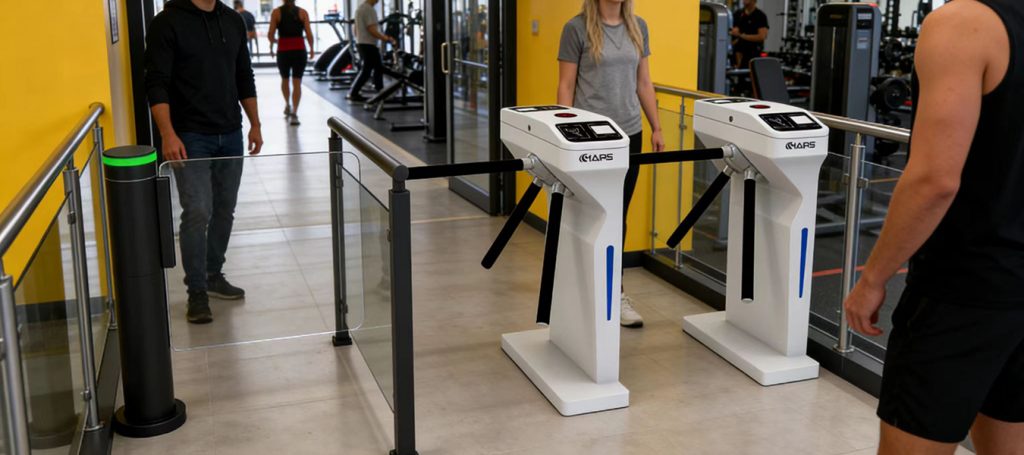
| Tripod Turnstile | Budget gym, high security | Low cost, robust structure, reliable anti-tailgating performance | Slow throughput | 15–25 ppm | $350–$1,600 |
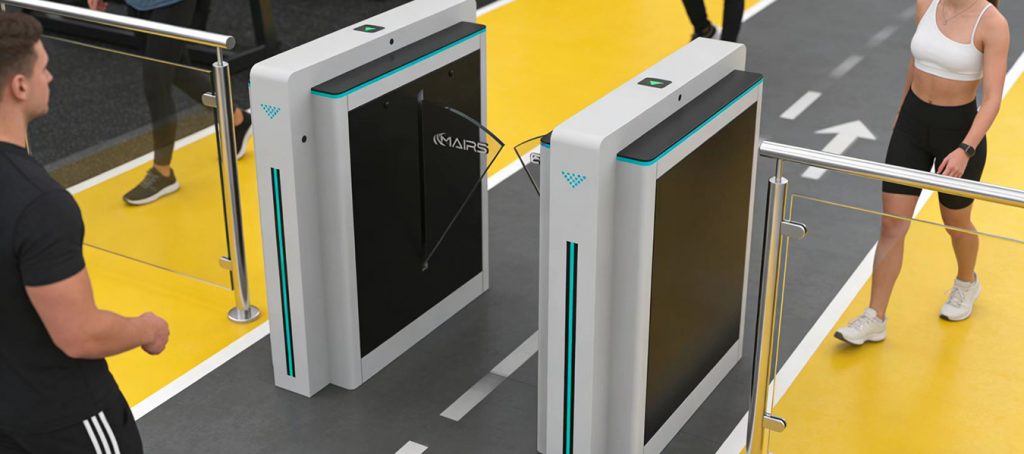
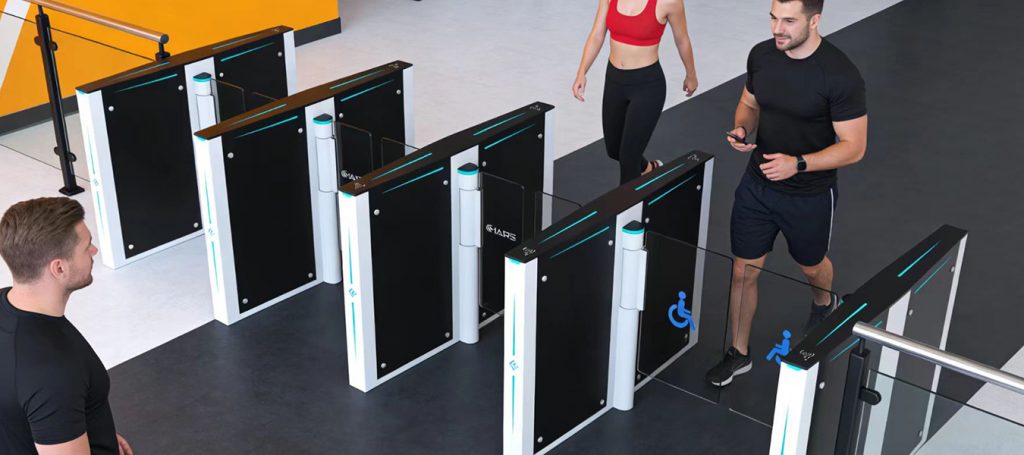
| Flap Barrier / Speed Gate | Premium gym, boutique fitness studio | Fast pass rate, modern aesthetic, high throughput | Higher cost | 40–80 ppm | $850–$8,000 |
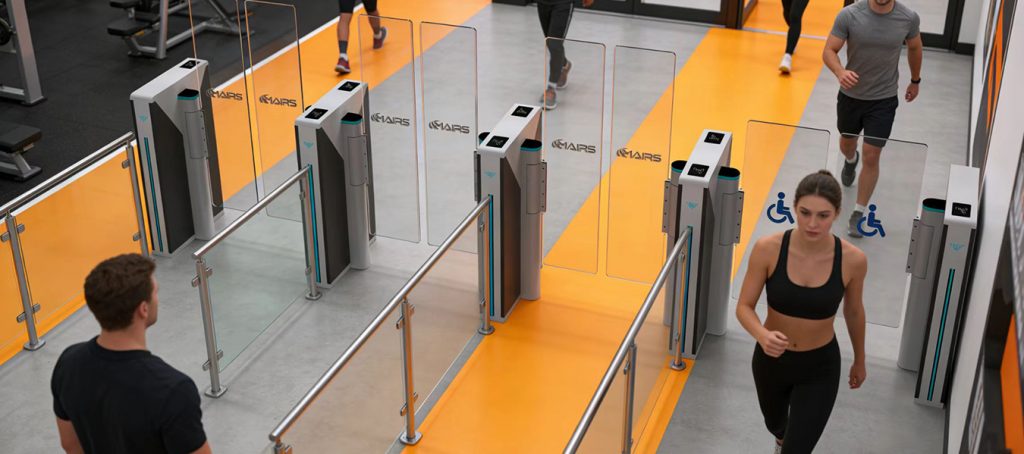
| Swing Turnstile | Need wheelchair/stroller access, ADA compliant | Wide passage lane | Medium security level | 30–50 ppm | $600–$2,500 |
| Full Height Turnstile | 24h self-service gym, high security | Extremely hard to tailgate or climb over | Bulky footprint, expensive | 25–40 ppm | $1800–$9,000 |
Note: Prices are indicative and vary by configuration, region, and supplier.
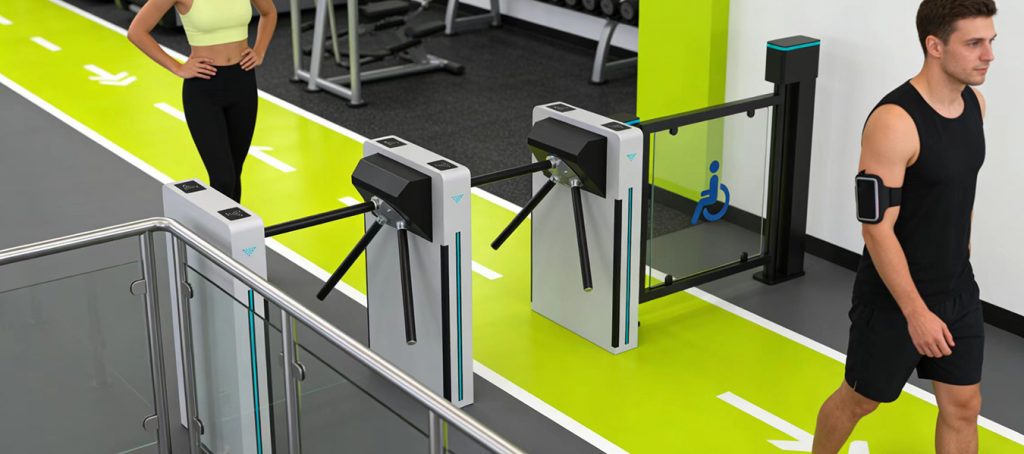
Tripod turnstiles remain the most popular choice for budget and mid-range gyms. They are the simplest and most cost-effective option, handling 15–25 passages per minute with a rugged three-arm rotating mechanism.
Flap barriers and speed gates deliver 40–80 ppm throughput with a premium aesthetic — glass panels, slim stainless steel cabinets, and opening times as fast as 0.3–0.5 seconds. These are ideal for premium and boutique fitness studios where brand image matters.
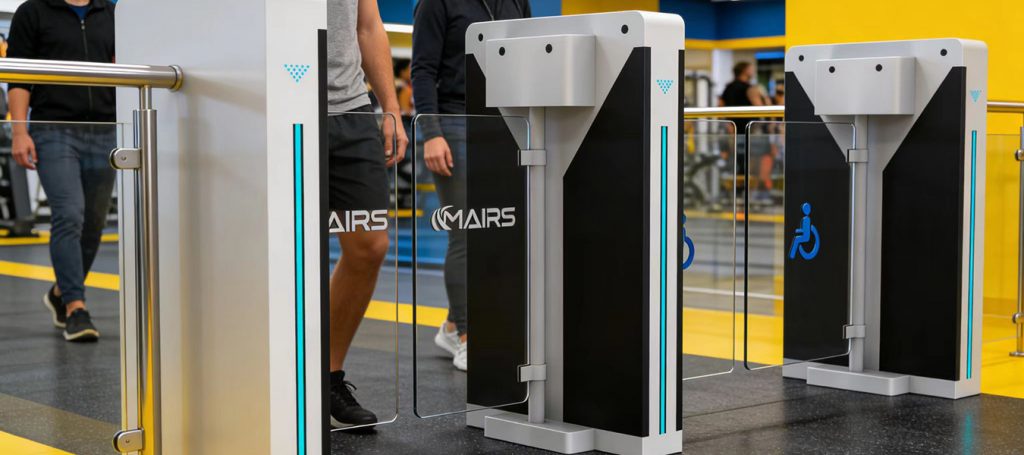
Swing barrier turnstiles accommodate wider passages and are the go-to choice when ADA compliance or stroller access is required.
Full-height security turnstiles provide the highest level of physical security, rotating a complete vertical cage assembly that prevents all tailgating by design. They suit 24/7 unattended gyms and high-security applications.
Key Features to Look for When Buying Gym Turnstiles
Anti-Tailgating Sensor Technology
This is the single most important feature for gym access control. Look for gym turnstiles equipped with advanced photocell and IR sensor technology capable of detecting unauthorized access attempts. Premium options include Improper Transit Control (ITC) and Single Person Detection (SPD), which detect tailgating, climbing over the cabinet, and false transit attempts.
Integration Capabilities
Your turnstile must communicate with your gym CRM and membership software. Check for these interfaces:
- Dry contact (standard): Works with virtually any access control system
- RS485/RS232: Common for industrial and multi-lane setups
- TCP/IP: Network-based integration for cloud-managed systems
Most gym management platforms — including Magicline, Virtuagym, ABC Glofox, and GymRoute — support native integration with turnstile hardware.
Reader Options
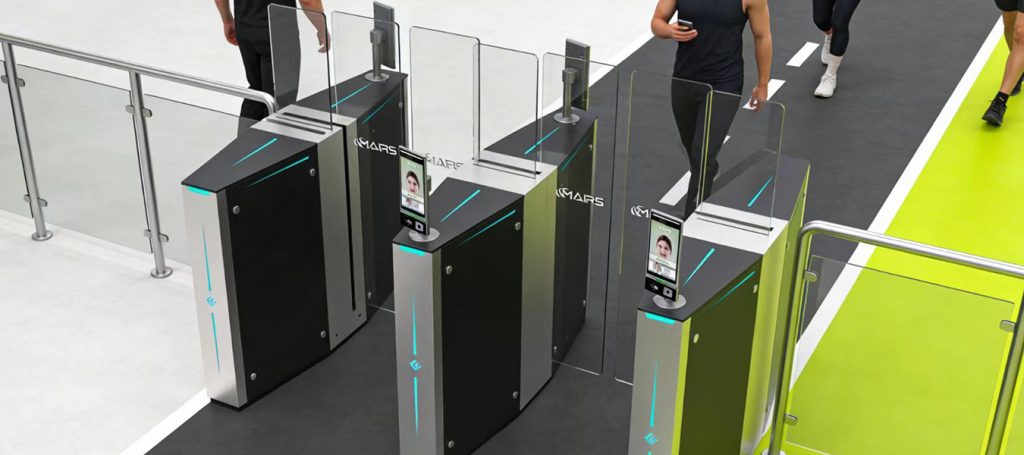
Choose from RFID cards, QR code scanners, NFC readers, or facial recognition terminals. Many modern turnstiles support parallel processing of facial recognition, QR codes, and RFID simultaneously, preventing bottlenecks regardless of traffic volume.
Material and Moisture Resistance
Gyms are humid environments. Specify SUS304 stainless steel construction with moisture-resistant internal components. Look for IPX4-level or higher water resistance ratings. This ensures the turnstile withstands sweat, cleaning chemicals, and ambient humidity without corrosion or electronic failure.
Emergency Release / Power Failure Safety
Always confirm that your turnstile supports fail-open configuration for emergency evacuation. Each direction on a control head can typically be independently configured to unlock upon power failure.
Customization Options
Many manufacturers offer custom RAL powder coat colors, logo printing on the top plate, and adjustable housing dimensions to match your brand identity and floor plan. Customization helps the turnstile blend seamlessly into your gym’s design.
How to Calculate How Many Gym Turnstiles You Need
The key formula for determining lane count is:
(Peak Hour Volume ÷ Time Allotted) ÷ Throughput per Lane = Number of Lanes Required
A good rule of thumb for throughput is approximately 3–4 seconds per person for optical or waist-high turnstiles, and 4 seconds for full-height turnstiles, assuming proximity card readers with a 250ms access response time.
Example: If your gym sees 400 members entering during a 30-minute peak window, and your turnstile processes 15 people per minute:
(400 ÷ 30) ÷ 15 = 0.89 → 1 turnstile minimum
However, consider adding a safety factor of 1.2–1.5× for guest traffic, class change surges, and system latency. For most commercial gyms with 500–2,000 members, 2–3 lanes (including at least one wide ADA-accessible lane) is a practical starting point. Always check class schedules and peak membership hours to validate your calculation.
Gym Turnstile Installation & Maintenance Tips
Site Survey and Preparation
Before installation, conduct a thorough site survey to assess:
- Floor space and lane width requirements (standard lanes range from 600mm to 900mm)
- Power source availability and wiring routes
- Whether floor conduits or embedded cables are needed — these should be completed before installation day
- Mounting surface: a level, solid concrete floor at least 4 inches (100mm) thick is recommended
Regular Maintenance Schedule
| Frequency | Tasks |
|---|---|
| 30 days after installation | Initial inspection of all installed turnstiles |
| Monthly | Visual inspection for loose screws, misaligned arms, water intrusion, or rust; clean sensor windows |
| Quarterly | Deeper inspection of internal mechanisms, PCBs, and power supplies |
| Twice yearly | Lubricate moving parts and inspect interior components — more frequently in humid environments |
Gym Turnstile Cost Factors
There is no single price for a gym turnstile. The final quotation depends on several key variables:
- Number of lanes: Multi-lane configurations significantly increase total project cost
- Authentication module: Basic RFID is the most economical; facial recognition terminals add significant cost
- Cabinet material: SUS201 stainless steel is budget-tier; SUS304 with full-weld construction costs more but offers superior corrosion resistance
- Motor type: Manual mechanical arms are cheapest; brushless DC motors cost more upfront but last 5–10 million cycles versus 2–3 million for brushed alternatives
- Functionality: Anti-tailgating sensors, emergency release, people counting, and alarm systems each add cost
- Customization: Custom colors, logos, and housing dimensions
- Shipping and installation: Site conditions, wiring complexity, and geographic location all affect the final number
The best approach is to define your required specifications first, then request itemized quotations from 2–3 suppliers for accurate comparison.
Common FAQs
What is the best turnstile for a gym?
There is no single “best” type — it depends on your gym’s positioning and budget. Tripod turnstiles suit budget gyms seeking robust, low-cost access control at 15–25 ppm. Flap barriers and speed gates are best for premium gyms that need 40–80 ppm throughput with a modern aesthetic. Full-height turnstiles are ideal for 24/7 unattended gyms where maximum security is required. Most commercial gyms find that a combination of 2–3 flap barriers or speed gates provides the optimal balance of throughput, security, and member experience.
Can gym turnstiles integrate with gym management software?
Yes. Most modern turnstiles support integration with leading gym CRM platforms through dry contact, RS485, or TCP/IP interfaces. Popular gym management systems like Magicline, Virtuagym, ABC Glofox, GymRoute, and others offer native turnstile integration, allowing automatic membership validation, real-time attendance tracking, and remote permission management.
Do gym turnstiles work with facial recognition?
Absolutely. Facial recognition is increasingly the preferred authentication method for gyms because it prevents card sharing — the system verifies not just credential validity but also the identity of the person presenting it. Modern terminals combine AI-powered facial recognition with RFID and QR code support, processing all three in parallel for maximum throughput. Note that under GDPR and similar privacy regulations, biometric data is classified as sensitive personal data, so proper consent, data retention policies, and alternative access methods must be provided.
Can gym turnstiles prevent tailgating?
Yes. Modern turnstiles use infrared sensor arrays and photocell technology to detect when more than one person attempts to pass through on a single credential. If a second person follows without swiping, the system triggers an alarm and can prevent the barrier from completing its cycle. Full-height turnstiles prevent tailgating entirely through their physical design.
What happens when power is lost for gym turnstiles?
Quality turnstiles are configured with fail-open (fail-safe) behavior. When primary power is lost, the locking mechanism releases and the arms rotate freely in both directions, allowing safe evacuation. The system resets automatically when power is restored. Each direction can be independently configured for fail-open or fail-lock depending on your safety requirements.
Are gym turnstiles suitable for 24-hour gyms?
Yes — turnstiles are essential for 24/7 gyms. They serve as the automated “front desk” during unstaffed hours, ensuring only paying members with valid credentials can enter. Anti-tailgating detection is particularly important in unstaffed facilities, where there is no human backstop to catch unauthorized entries. Some systems pair turnstile entry data with camera feeds, so if someone follows a member through during unstaffed hours, the system flags it and you know exactly who entered.
Conclusion
Gym turnstiles are no longer a luxury — they are a core operational tool for fitness facilities of every size. Gym turnstiles protect your gym revenue, cut operational costs, improve member experience and bring reliable access control for all fitness facilities, from small budget studios to large 24-hour self-service gyms. Choosing the right turnstile type, sensors and integration setup is critical for long-term performance.
Whether you run a budget gym, a premium boutique studio, or a 24-hour self-service facility, there is a turnstile configuration that fits your space, your members, and your budget.
Ready to upgrade your gym’s access control? Contact our team for a free consultation and customized quotation. We will help you select the right turnstile type, calculate the optimal number of lanes, and design an integration plan that works with your existing gym management software.